# Summerstone (https://summerstone.xyz/index.md)
Expanding onchain markets.
Summerstone builds infrastructure for onchain markets with production systems across borrowing, yield, liquidity, and research.
## Primary pages
- [Borrowing](https://summerstone.xyz/borrowing.md): Automated borrowing for Liquity-based protocols.
- [Yield](https://summerstone.xyz/yield.md): Curated yield strategies and vault frameworks.
- [Liquidity](https://summerstone.xyz/liquidity.md): Market operations and execution tooling.
- [Research](https://summerstone.xyz/research.md): Long-form publications and market analysis.
- [Blog](https://summerstone.xyz/blog.md): Announcements and ecosystem updates.
- [Documentation](https://summerstone.xyz/docs.md): Product documentation and guides.
# About Summerstone (https://summerstone.xyz/about.md)
We excel at the intersection of onchain markets, realtime data and quantitative and agentic algorithms.
## Vision and mission
Summerstone is focused on expanding fair, efficient, and predictable onchain markets for people and businesses worldwide.
## Values
- Reliability: production-first engineering and operational rigor.
- Security: defense-in-depth and explicit risk management.
- Focus: solve a few hard problems exceptionally well.
Related pages: [Borrowing](https://summerstone.xyz/borrowing.md), [Research](https://summerstone.xyz/research.md), [Docs](https://summerstone.xyz/docs.md)
# Effortlessly optimized borrowing (https://summerstone.xyz/borrowing.md)
Summerstone is the leading provider of set-and-forget interest rates on Liquity-based borrowing markets.
## Product overview
Automated Borrowing automates interest-rate adjustments for collateral-backed loans while preserving user custody.
## Supported protocols
- Liquity V2 (BOLD, Ethereum): [docs](https://summerstone.xyz/docs/borrowing/supported-protocols/bold-and-liquity-v2.md)
- Nerite (USND, Arbitrum One): [docs](https://summerstone.xyz/docs/borrowing/supported-protocols/usnd-and-nerite.md)
- Soneta (ONE, Sonic Mainnet): [docs](https://summerstone.xyz/docs/borrowing/supported-protocols/one-and-soneta.md)
- Mustang (MUST, Saga EVM): [docs](https://summerstone.xyz/docs/borrowing/supported-protocols/must-and-mustang.md)
## Guarantees
- Self-custody delegation.
- Protocol-enforced fee/adjustment constraints.
- Gas costs for adjustment execution covered by Summerstone.
# Summerstone Documentation (https://summerstone.xyz/docs.md)
# Overview (https://summerstone.xyz/docs/borrowing.md)
Summerstone’s rate automation solution is designed specifically for users who value:
* **Self-custody:** Retain full control of your funds at all times.
* **Efficiency:** Automated adjustments eliminate manual work, reducing stress and costs.
* **Transparency:** All actions and parameters are fully verifiable directly onchain.
Chat with our docs using an LLM using [this LLM-friendly text file](https://summerstone.xyz/llms-full.txt) of the full documentation.
## Security and Transparency
All parameters are verifiable onchain, providing absolute transparency and security:
* **Fixed Service Fee:** A maximum fee of 0.3% annually.
* **Adjustment Frequency:** Normal adjustments no more frequently than once per week.
* **Immutable Guarantees:** Parameters enforced by smart contracts.
## How the Automated Adjustment Process Works
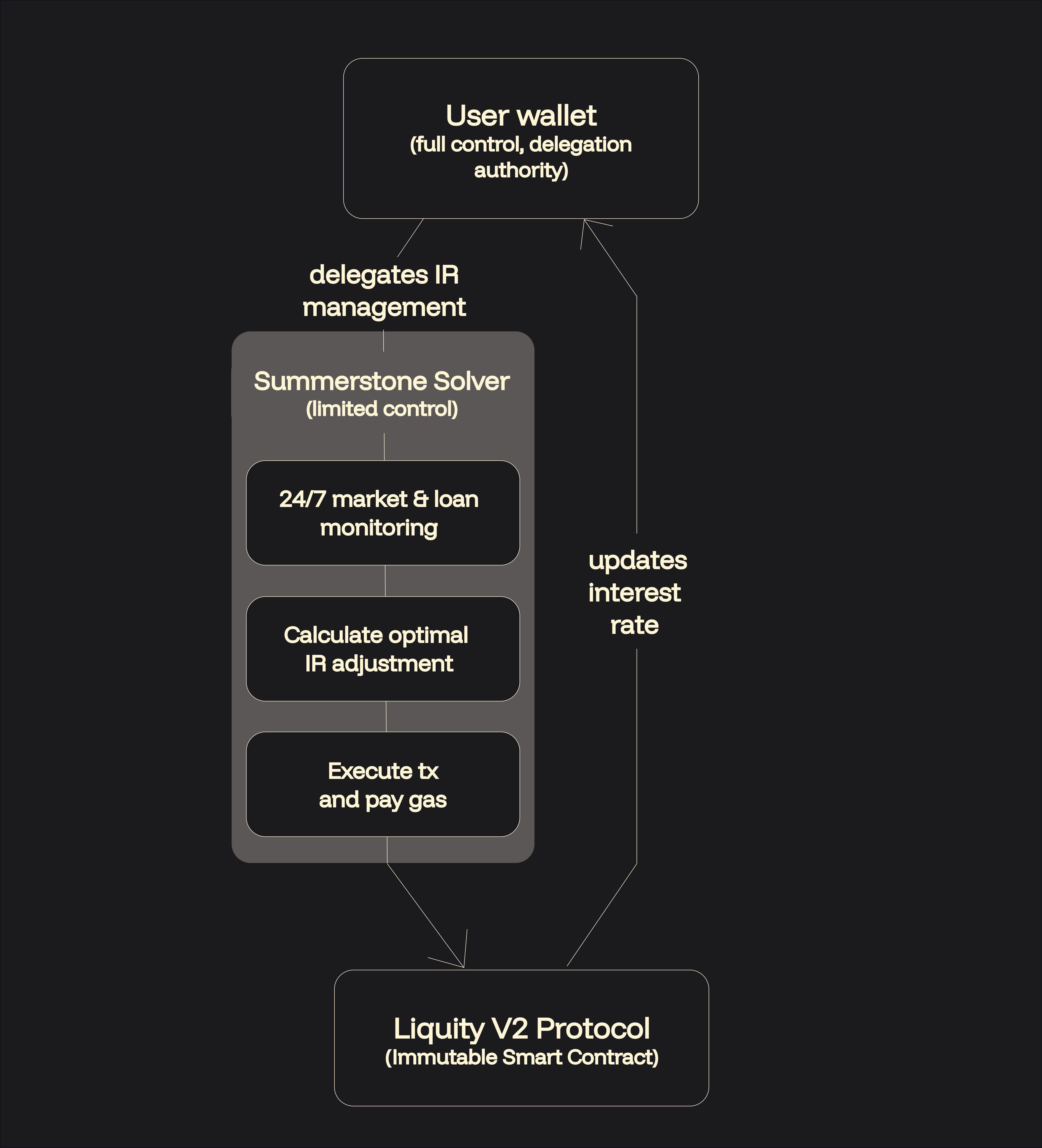
The following diagram illustrates how Summerstone’s automated interest rate strategies interact with loans and the Liquity-V2-based protocols:
 ### Explanation of the Diagram:
* **Delegation:** You delegate authority to adjust your loan’s interest rate (no fund custody involved).
* **Monitoring:** Our algorithm constantly evaluates market conditions, including debt positions, redemption risks, and gas conditions.
* **Adjustment Calculation:** The solver computes the optimal interest rate adjustments based on your preset risk strategy.
* **Execution:** Adjustments are securely executed directly on the Liquity V2 protocol, reflected transparently onchain.
## Getting Started:
1. Open your loan settings in a supported frontend of your chosen protocol.
2. Delegate interest rate automation to our verified address. Check our [supported protocols](/docs/borrowing/supported-protocols).
3. Confirm the transaction - your loans are now fully automated.
# Frequently Asked Questions (FAQs) (https://summerstone.xyz/docs/borrowing/frequently-asked-questions.md)
## What exactly does Summerstone do?
Summerstone provides automated interest rate adjustments for your Liquity V2-based loans. By continuously monitoring market conditions, our system optimally adjusts your interest rate to keep borrowing costs low, proactively minimize redemption risk, and eliminate the hassle of manual adjustments.
***
## How do automated interest rate adjustments work?
Our system monitors key metrics continuously, including:
* Redemption risk and debt positions
* Market price fluctuations
* Network gas conditions
* Liquity protocol status and events
Based on these metrics, our algorithms determine precisely when and how to adjust your loan's interest rate, optimizing your borrowing efficiency.
***
## How much does Summerstone cost?
We charge a straightforward 0.3% annual service fee based on your total loan amount, enforced transparently by the protocol. For most users, these costs are offset by:
* Reduced gas expenses from eliminating manual adjustments
* Lower average interest rates
* Reduced risk of redemption penalties
You can calculate your exact potential savings using our [Savings Calculator](/docs/borrowing/savings-calculator).
***
## Is delegating interest rate adjustments secure?
Yes. Delegation through Liquity V2 protocols is inherently safe and limited:
* Delegates / batch managers **only** have the ability to adjust interest rates.
* Delegates / batch managers **cannot** access or transfer your funds or modify other loan parameters.
* Delegation permissions and boundaries are verifiable directly onchain.
***
## Can Summerstone guarantee protection against redemptions?
While our automated system significantly reduces the likelihood of redemption by proactively adjusting rates, we cannot guarantee complete protection due to inherent market volatility and liquidity factors.
Please review our comprehensive [Terms of Service](/docs/borrowing/terms-of-service) to understand these risks fully.
***
## Which frontends can I use?
Liquity does not run its own frontend. You can use any frontend that supports interest rate delegation for Liquity V2 protocols. You can find independent frontends [here](https://www.liquity.org/frontend-v2) or just head to [liquity.app](https://liquity.app/).
***
## How frequently are interest rates adjusted?
Adjustments typically happen at most once per week under normal conditions. During high-risk periods, adjustments may occur more frequently as needed, within the limits enforced by the Liquity protocol.
***
## Do rates differ based on collateral types?
Yes. Interest rates are optimized individually for each collateral type to manage risk effectively. Each collateral type has its own optimal range for safe borrowing.
***
## Can I stop using Summerstone at any time?
Absolutely. You retain full control and can revoke interest rate delegation at any moment directly from your wallet.
***
## Which Liquity V2 forks and stablecoins are supported?
We support multiple popular Liquity V2 forks and stablecoins used actively by the community. You can find the full list of supported protocols in our [Supported Protocols](/docs/borrowing/supported-protocols) section.
# Savings Calculator (https://summerstone.xyz/docs/borrowing/savings-calculator.md)
Our Return on Investment (ROI) calculator helps you determine how much you can save by using Summerstone's automated interest rate strategies. Compare the costs of manual adjustments to our automated solution and see the benefits over time.
## How the Calculator Works
The calculator compares two approaches to interest rate adjustments:
### Manual Costs
When adjusting interest rates manually, you incur two types of costs:
1. **Gas Costs:** The ETH transaction fees paid each time you adjust your rate
2. **Interest Rate Loss:** The additional interest costs from suboptimal rate adjustments
### Automated Borrowing Benefits
With Summerstone's automated borrowing, you pay a small fee but gain several benefits:
1. **Optimal Rate Adjustments:** Our solvers monitor the market continuously
2. **Zero Gas Costs:** We handle all transaction expenses
3. **MEV Protection:** Our specialized infrastructure protects your transactions
## Customization Options
You can adjust several parameters to match your specific situation:
* **Loan Size:** The principal amount of your loan (affects both service fees and potential savings)
* **Adjustment Frequency:** How often you would typically adjust rates if adjusting manually
* **Gas Price:** Expected network conditions and transaction costs
**Advanced options** allow you to fine-tune:
* **Gas Units Per Adjustment:** Complexity of your adjustment transactions
* **ETH Price:** Current market value of Ethereum
* **Interest Rate Optimization:** Estimated savings from optimal rate adjustments
* **Calculation Timeframe:** View results over 1, 2, or 5 years
## Understanding the Chart
The chart visualizes the comparison between costs and benefits over time:
* **Red Bars (Below Axis):** Service fees (costs)
* **Green Bars (Above Axis):** Gas cost savings
* **Blue Bars (Above Axis):** Interest savings from optimal rate adjustments
* **White Line:** Net value (when this crosses above zero, you achieve positive ROI)
This visualization makes it easy to see exactly when automated borrowing starts providing positive returns on your investment.
# Supported Protocols (https://summerstone.xyz/docs/borrowing/supported-protocols.md)
{/* */}
{/* */}
# MUST and Mustang (https://summerstone.xyz/docs/borrowing/supported-protocols/_must-and-mustang.md)
MUST is a USD-pegged stablecoin issued by the Mustang protocol on Saga EVM.
| Property | Value |
| --------------------------- | -------------------------------------------------------------------- |
| Protocol | Mustang ([https://must.finance](https://must.finance)) |
| Frontend | [https://app.must.finance](https://app.must.finance) |
| Stablecoin Symbol | MUST |
| Blockchain | Saga EVM |
| Chain ID | `5464` |
| Stablecoin Contract Address | `0xa8b56ce258a7f55327bde886b0e947ee059ca434` |
| Blockchain Explorer | [https://sagaevm.sagaexplorer.io/](https://sagaevm.sagaexplorer.io/) |
The information provided on this page is for informational purposes only and does not constitute financial, investment, or trading advice. Please review our [Terms of Service](/docs/borrowing/terms-of-service) before using any services described here.
## Active Strategies
# ONE and Soneta (https://summerstone.xyz/docs/borrowing/supported-protocols/_one-and-soneta.md)
ONE is a USD-pegged stablecoin issued by the Soneta protocol on Sonic.
| Property | Value |
| --------------------------- | ------------------------------------------------------------ |
| Protocol | Soneta ([https://soneta.xyz](https://soneta.xyz)) |
| Frontend | [https://www.soneta.xyz/lobby](https://www.soneta.xyz/lobby) |
| Stablecoin Symbol | ONE |
| Blockchain | Sonic |
| Chain ID | `146` |
| Stablecoin Contract Address | 0x8ed344E89527C6cE382fd1E23B4D6D4c2865b6A9 |
| Blockchain Explorer | [https://sonicscan.org](https://sonicscan.org) |
The information provided on this page is for informational purposes only and does not constitute financial, investment, or trading advice. Please review our [Terms of Service](/docs/borrowing/terms-of-service) before using any services described here.
## Active Strategies
# BOLD and Liquity V2 (https://summerstone.xyz/docs/borrowing/supported-protocols/bold-and-liquity-v2.md)
BOLD is a USD-pegged stablecoin issued by the Liquity V2 protocol on Ethereum Mainnet.
| Property | Value |
| --------------------------- | -------------------------------------------------------------------------- |
| Protocol | Liquity V2 ([https://liquity.org](https://liquity.org)) |
| Frontend | [https://liquity.app](https://liquity.app) |
| Stablecoin Symbol | BOLD |
| Blockchain | Ethereum Mainnet |
| Chain ID | `1` |
| Stablecoin Contract Address | `0x6440f144b7e50D6a8439336510312d2F54beB01D` |
| Blockchain Explorer | [https://etherscan.io](https://etherscan.io) |
| Protocol Explorer | [https://dune.com/liquity/liquity-v2](https://dune.com/liquity/liquity-v2) |
The information provided on this page is for informational purposes only and does not constitute financial, investment, or trading advice. Please review our [Terms of Service](/docs/borrowing/terms-of-service) before using any services described here.
## Active Strategies
# USND and Nerite (https://summerstone.xyz/docs/borrowing/supported-protocols/usnd-and-nerite.md)
USND is a USD-pegged stablecoin issued by the Nerite protocol on Arbitrum One.
| Property | Value |
| --------------------------- | ------------------------------------------------- |
| Protocol | Nerite ([https://nerite.org](https://nerite.org)) |
| Frontend | [https://app.nerite.org](https://app.nerite.org) |
| Stablecoin Symbol | USND |
| Blockchain | Arbitrum One |
| Chain ID | `42161` |
| Stablecoin Contract Address | `0x4ecf61a6c2fab8a047ceb3b3b263b401763e9d49` |
| Blockchain Explorer | [https://arbiscan.io](https://arbiscan.io) |
The information provided on this page is for informational purposes only and does not constitute financial, investment, or trading advice. Please review our [Terms of Service](/docs/borrowing/terms-of-service) before using any services described here.
## Active Strategies
# Terms of Service (https://summerstone.xyz/docs/borrowing/terms-of-service.md)
These Terms of Service (the "Terms") explain what happens when you appoint us as your **non‑custodial rate automation provider** (the "Service"). You do that by setting our delegate address for your loan(s) on one or more independent lending protocols ("Core Protocols"). If you do not agree to these Terms, do not set that delegation.
## 1. Who may use the Service
* You are at least 18 years old and legally able to make contracts.
* You follow the laws of your country. If local rules ban blockchain borrowing tools, do not use the Service.
## 2. What we do - and **don't** do
* **Delegate only.** Using your own wallet, you give our address limited authority to automate the interest‑rate settings of your loan. Nothing more.
* **No custody.** We never hold your assets or private keys. The Core Protocols still hold collateral and debt. You can revoke our delegation at any time with your wallet.
* **No control over Core Protocols.** We did not build them, cannot fix them, and cannot stop unexpected behavior.
* **No guarantees or advice.** We do not promise to lower your rate, prevent liquidation, or achieve any outcome. Nothing we say is financial, legal, tax, or trading advice.
* **Off‑chain actions.** After delegation, our off-chain systems may act on your behalf within the constraints defined. We are **not obliged** to act, and any action may be skipped, delayed, or fail.
* **Not a regulated entity.** We are not a bank, broker, exchange, or money‑service business, and we are not regulated as one.
## 3. Big risks you accept
1. **Protocol bugs or hacks.** Core Protocols can fail or be exploited; our off‑chain systems may also malfunction.
2. **Interest‑rate swings.** Rates can spike suddenly, and our solvers might not react in time - or at all.
3. **Liquidations.** Falling collateral value can trigger automatic liquidations, irrespective of your interest rate.
4. **Network congestion.** High gas fees or chain delays can stop us from acting when needed.
5. **Regulatory changes.** Laws can change and make it hard or illegal for you to repay or keep using blockchain tools.
## 4. Your responsibilities
* **Maintain collateral.** You are responsible for monitoring collateral levels and adding more if needed.
* **Stay legal.** Do not use the Service for money laundering, sanctions evasion, or any crime.
* **Understand the rules.** Read how our delegate operates before you enable it.
* **Indemnity.** If someone sues us because of something you did, you will cover our costs (including lawyers' fees).
## 5. No promises ("As Is")
The Service is provided **"as is" and "as available."** We make **no warranty** - not for uptime, accuracy, security, or any result. We may miss triggers, execute late, or fail completely. You accept that risk.
## 6. Limits of liability
To the fullest extent allowed by law:
* We are **not** responsible for any indirect, special, or consequential loss; lost profits; lost data; or loss of goodwill.
* If we are found liable anyway, our total liability is capped at **US $1.00**.
## 7. Stopping or changing the Service
We may upgrade, pause, or shut down our off‑chain systems or resign our delegate address without notice. You can revoke delegation at any time.
## 8. Disputes
* **Informal resolution first.** Contact us; we will try to resolve any issue in good faith.
* **Arbitration.** If we cannot settle it informally within 30 days, any dispute will be resolved individually and confidentially by binding arbitration under widely accepted international rules. The arbitrator's decision is final and enforceable.
* **No class actions.** You and we may bring claims only on our own behalf, not as part of a class, collective, or representative action.
## 9. Updates to these Terms
We may update these Terms by publishing a new version at any time. Using the Service after the update means you accept the new Terms.
**By delegating interest rate automation to our address, you confirm that you have read, understood, and agreed to these Terms, and that you accept all risks described above.**
# Why Automate Your Interest Rate? (https://summerstone.xyz/docs/borrowing/why-automate-your-interest-rate.md)
Automating interest rate adjustments maximizes your capital efficiency and significantly reduces redemption risks and costs:
* **Zero Gas Fees:** All adjustment-related gas costs are covered by us.
* **Optimal Rates:** Real-time market monitoring ensures adjustments are executed precisely and timely.
* **Proactive Adjustments:** Risk of redemptions is actively minimized through proactive adjustments.
## Manual vs. Automated
The following diagram compares Summerstone's automated approach to manual adjustments:
### Explanation of the Diagram:
* **Delegation:** You delegate authority to adjust your loan’s interest rate (no fund custody involved).
* **Monitoring:** Our algorithm constantly evaluates market conditions, including debt positions, redemption risks, and gas conditions.
* **Adjustment Calculation:** The solver computes the optimal interest rate adjustments based on your preset risk strategy.
* **Execution:** Adjustments are securely executed directly on the Liquity V2 protocol, reflected transparently onchain.
## Getting Started:
1. Open your loan settings in a supported frontend of your chosen protocol.
2. Delegate interest rate automation to our verified address. Check our [supported protocols](/docs/borrowing/supported-protocols).
3. Confirm the transaction - your loans are now fully automated.
# Frequently Asked Questions (FAQs) (https://summerstone.xyz/docs/borrowing/frequently-asked-questions.md)
## What exactly does Summerstone do?
Summerstone provides automated interest rate adjustments for your Liquity V2-based loans. By continuously monitoring market conditions, our system optimally adjusts your interest rate to keep borrowing costs low, proactively minimize redemption risk, and eliminate the hassle of manual adjustments.
***
## How do automated interest rate adjustments work?
Our system monitors key metrics continuously, including:
* Redemption risk and debt positions
* Market price fluctuations
* Network gas conditions
* Liquity protocol status and events
Based on these metrics, our algorithms determine precisely when and how to adjust your loan's interest rate, optimizing your borrowing efficiency.
***
## How much does Summerstone cost?
We charge a straightforward 0.3% annual service fee based on your total loan amount, enforced transparently by the protocol. For most users, these costs are offset by:
* Reduced gas expenses from eliminating manual adjustments
* Lower average interest rates
* Reduced risk of redemption penalties
You can calculate your exact potential savings using our [Savings Calculator](/docs/borrowing/savings-calculator).
***
## Is delegating interest rate adjustments secure?
Yes. Delegation through Liquity V2 protocols is inherently safe and limited:
* Delegates / batch managers **only** have the ability to adjust interest rates.
* Delegates / batch managers **cannot** access or transfer your funds or modify other loan parameters.
* Delegation permissions and boundaries are verifiable directly onchain.
***
## Can Summerstone guarantee protection against redemptions?
While our automated system significantly reduces the likelihood of redemption by proactively adjusting rates, we cannot guarantee complete protection due to inherent market volatility and liquidity factors.
Please review our comprehensive [Terms of Service](/docs/borrowing/terms-of-service) to understand these risks fully.
***
## Which frontends can I use?
Liquity does not run its own frontend. You can use any frontend that supports interest rate delegation for Liquity V2 protocols. You can find independent frontends [here](https://www.liquity.org/frontend-v2) or just head to [liquity.app](https://liquity.app/).
***
## How frequently are interest rates adjusted?
Adjustments typically happen at most once per week under normal conditions. During high-risk periods, adjustments may occur more frequently as needed, within the limits enforced by the Liquity protocol.
***
## Do rates differ based on collateral types?
Yes. Interest rates are optimized individually for each collateral type to manage risk effectively. Each collateral type has its own optimal range for safe borrowing.
***
## Can I stop using Summerstone at any time?
Absolutely. You retain full control and can revoke interest rate delegation at any moment directly from your wallet.
***
## Which Liquity V2 forks and stablecoins are supported?
We support multiple popular Liquity V2 forks and stablecoins used actively by the community. You can find the full list of supported protocols in our [Supported Protocols](/docs/borrowing/supported-protocols) section.
# Savings Calculator (https://summerstone.xyz/docs/borrowing/savings-calculator.md)
Our Return on Investment (ROI) calculator helps you determine how much you can save by using Summerstone's automated interest rate strategies. Compare the costs of manual adjustments to our automated solution and see the benefits over time.
## How the Calculator Works
The calculator compares two approaches to interest rate adjustments:
### Manual Costs
When adjusting interest rates manually, you incur two types of costs:
1. **Gas Costs:** The ETH transaction fees paid each time you adjust your rate
2. **Interest Rate Loss:** The additional interest costs from suboptimal rate adjustments
### Automated Borrowing Benefits
With Summerstone's automated borrowing, you pay a small fee but gain several benefits:
1. **Optimal Rate Adjustments:** Our solvers monitor the market continuously
2. **Zero Gas Costs:** We handle all transaction expenses
3. **MEV Protection:** Our specialized infrastructure protects your transactions
## Customization Options
You can adjust several parameters to match your specific situation:
* **Loan Size:** The principal amount of your loan (affects both service fees and potential savings)
* **Adjustment Frequency:** How often you would typically adjust rates if adjusting manually
* **Gas Price:** Expected network conditions and transaction costs
**Advanced options** allow you to fine-tune:
* **Gas Units Per Adjustment:** Complexity of your adjustment transactions
* **ETH Price:** Current market value of Ethereum
* **Interest Rate Optimization:** Estimated savings from optimal rate adjustments
* **Calculation Timeframe:** View results over 1, 2, or 5 years
## Understanding the Chart
The chart visualizes the comparison between costs and benefits over time:
* **Red Bars (Below Axis):** Service fees (costs)
* **Green Bars (Above Axis):** Gas cost savings
* **Blue Bars (Above Axis):** Interest savings from optimal rate adjustments
* **White Line:** Net value (when this crosses above zero, you achieve positive ROI)
This visualization makes it easy to see exactly when automated borrowing starts providing positive returns on your investment.
# Supported Protocols (https://summerstone.xyz/docs/borrowing/supported-protocols.md)
{/* */}
{/* */}
# MUST and Mustang (https://summerstone.xyz/docs/borrowing/supported-protocols/_must-and-mustang.md)
MUST is a USD-pegged stablecoin issued by the Mustang protocol on Saga EVM.
| Property | Value |
| --------------------------- | -------------------------------------------------------------------- |
| Protocol | Mustang ([https://must.finance](https://must.finance)) |
| Frontend | [https://app.must.finance](https://app.must.finance) |
| Stablecoin Symbol | MUST |
| Blockchain | Saga EVM |
| Chain ID | `5464` |
| Stablecoin Contract Address | `0xa8b56ce258a7f55327bde886b0e947ee059ca434` |
| Blockchain Explorer | [https://sagaevm.sagaexplorer.io/](https://sagaevm.sagaexplorer.io/) |
The information provided on this page is for informational purposes only and does not constitute financial, investment, or trading advice. Please review our [Terms of Service](/docs/borrowing/terms-of-service) before using any services described here.
## Active Strategies
# ONE and Soneta (https://summerstone.xyz/docs/borrowing/supported-protocols/_one-and-soneta.md)
ONE is a USD-pegged stablecoin issued by the Soneta protocol on Sonic.
| Property | Value |
| --------------------------- | ------------------------------------------------------------ |
| Protocol | Soneta ([https://soneta.xyz](https://soneta.xyz)) |
| Frontend | [https://www.soneta.xyz/lobby](https://www.soneta.xyz/lobby) |
| Stablecoin Symbol | ONE |
| Blockchain | Sonic |
| Chain ID | `146` |
| Stablecoin Contract Address | 0x8ed344E89527C6cE382fd1E23B4D6D4c2865b6A9 |
| Blockchain Explorer | [https://sonicscan.org](https://sonicscan.org) |
The information provided on this page is for informational purposes only and does not constitute financial, investment, or trading advice. Please review our [Terms of Service](/docs/borrowing/terms-of-service) before using any services described here.
## Active Strategies
# BOLD and Liquity V2 (https://summerstone.xyz/docs/borrowing/supported-protocols/bold-and-liquity-v2.md)
BOLD is a USD-pegged stablecoin issued by the Liquity V2 protocol on Ethereum Mainnet.
| Property | Value |
| --------------------------- | -------------------------------------------------------------------------- |
| Protocol | Liquity V2 ([https://liquity.org](https://liquity.org)) |
| Frontend | [https://liquity.app](https://liquity.app) |
| Stablecoin Symbol | BOLD |
| Blockchain | Ethereum Mainnet |
| Chain ID | `1` |
| Stablecoin Contract Address | `0x6440f144b7e50D6a8439336510312d2F54beB01D` |
| Blockchain Explorer | [https://etherscan.io](https://etherscan.io) |
| Protocol Explorer | [https://dune.com/liquity/liquity-v2](https://dune.com/liquity/liquity-v2) |
The information provided on this page is for informational purposes only and does not constitute financial, investment, or trading advice. Please review our [Terms of Service](/docs/borrowing/terms-of-service) before using any services described here.
## Active Strategies
# USND and Nerite (https://summerstone.xyz/docs/borrowing/supported-protocols/usnd-and-nerite.md)
USND is a USD-pegged stablecoin issued by the Nerite protocol on Arbitrum One.
| Property | Value |
| --------------------------- | ------------------------------------------------- |
| Protocol | Nerite ([https://nerite.org](https://nerite.org)) |
| Frontend | [https://app.nerite.org](https://app.nerite.org) |
| Stablecoin Symbol | USND |
| Blockchain | Arbitrum One |
| Chain ID | `42161` |
| Stablecoin Contract Address | `0x4ecf61a6c2fab8a047ceb3b3b263b401763e9d49` |
| Blockchain Explorer | [https://arbiscan.io](https://arbiscan.io) |
The information provided on this page is for informational purposes only and does not constitute financial, investment, or trading advice. Please review our [Terms of Service](/docs/borrowing/terms-of-service) before using any services described here.
## Active Strategies
# Terms of Service (https://summerstone.xyz/docs/borrowing/terms-of-service.md)
These Terms of Service (the "Terms") explain what happens when you appoint us as your **non‑custodial rate automation provider** (the "Service"). You do that by setting our delegate address for your loan(s) on one or more independent lending protocols ("Core Protocols"). If you do not agree to these Terms, do not set that delegation.
## 1. Who may use the Service
* You are at least 18 years old and legally able to make contracts.
* You follow the laws of your country. If local rules ban blockchain borrowing tools, do not use the Service.
## 2. What we do - and **don't** do
* **Delegate only.** Using your own wallet, you give our address limited authority to automate the interest‑rate settings of your loan. Nothing more.
* **No custody.** We never hold your assets or private keys. The Core Protocols still hold collateral and debt. You can revoke our delegation at any time with your wallet.
* **No control over Core Protocols.** We did not build them, cannot fix them, and cannot stop unexpected behavior.
* **No guarantees or advice.** We do not promise to lower your rate, prevent liquidation, or achieve any outcome. Nothing we say is financial, legal, tax, or trading advice.
* **Off‑chain actions.** After delegation, our off-chain systems may act on your behalf within the constraints defined. We are **not obliged** to act, and any action may be skipped, delayed, or fail.
* **Not a regulated entity.** We are not a bank, broker, exchange, or money‑service business, and we are not regulated as one.
## 3. Big risks you accept
1. **Protocol bugs or hacks.** Core Protocols can fail or be exploited; our off‑chain systems may also malfunction.
2. **Interest‑rate swings.** Rates can spike suddenly, and our solvers might not react in time - or at all.
3. **Liquidations.** Falling collateral value can trigger automatic liquidations, irrespective of your interest rate.
4. **Network congestion.** High gas fees or chain delays can stop us from acting when needed.
5. **Regulatory changes.** Laws can change and make it hard or illegal for you to repay or keep using blockchain tools.
## 4. Your responsibilities
* **Maintain collateral.** You are responsible for monitoring collateral levels and adding more if needed.
* **Stay legal.** Do not use the Service for money laundering, sanctions evasion, or any crime.
* **Understand the rules.** Read how our delegate operates before you enable it.
* **Indemnity.** If someone sues us because of something you did, you will cover our costs (including lawyers' fees).
## 5. No promises ("As Is")
The Service is provided **"as is" and "as available."** We make **no warranty** - not for uptime, accuracy, security, or any result. We may miss triggers, execute late, or fail completely. You accept that risk.
## 6. Limits of liability
To the fullest extent allowed by law:
* We are **not** responsible for any indirect, special, or consequential loss; lost profits; lost data; or loss of goodwill.
* If we are found liable anyway, our total liability is capped at **US $1.00**.
## 7. Stopping or changing the Service
We may upgrade, pause, or shut down our off‑chain systems or resign our delegate address without notice. You can revoke delegation at any time.
## 8. Disputes
* **Informal resolution first.** Contact us; we will try to resolve any issue in good faith.
* **Arbitration.** If we cannot settle it informally within 30 days, any dispute will be resolved individually and confidentially by binding arbitration under widely accepted international rules. The arbitrator's decision is final and enforceable.
* **No class actions.** You and we may bring claims only on our own behalf, not as part of a class, collective, or representative action.
## 9. Updates to these Terms
We may update these Terms by publishing a new version at any time. Using the Service after the update means you accept the new Terms.
**By delegating interest rate automation to our address, you confirm that you have read, understood, and agreed to these Terms, and that you accept all risks described above.**
# Why Automate Your Interest Rate? (https://summerstone.xyz/docs/borrowing/why-automate-your-interest-rate.md)
Automating interest rate adjustments maximizes your capital efficiency and significantly reduces redemption risks and costs:
* **Zero Gas Fees:** All adjustment-related gas costs are covered by us.
* **Optimal Rates:** Real-time market monitoring ensures adjustments are executed precisely and timely.
* **Proactive Adjustments:** Risk of redemptions is actively minimized through proactive adjustments.
## Manual vs. Automated
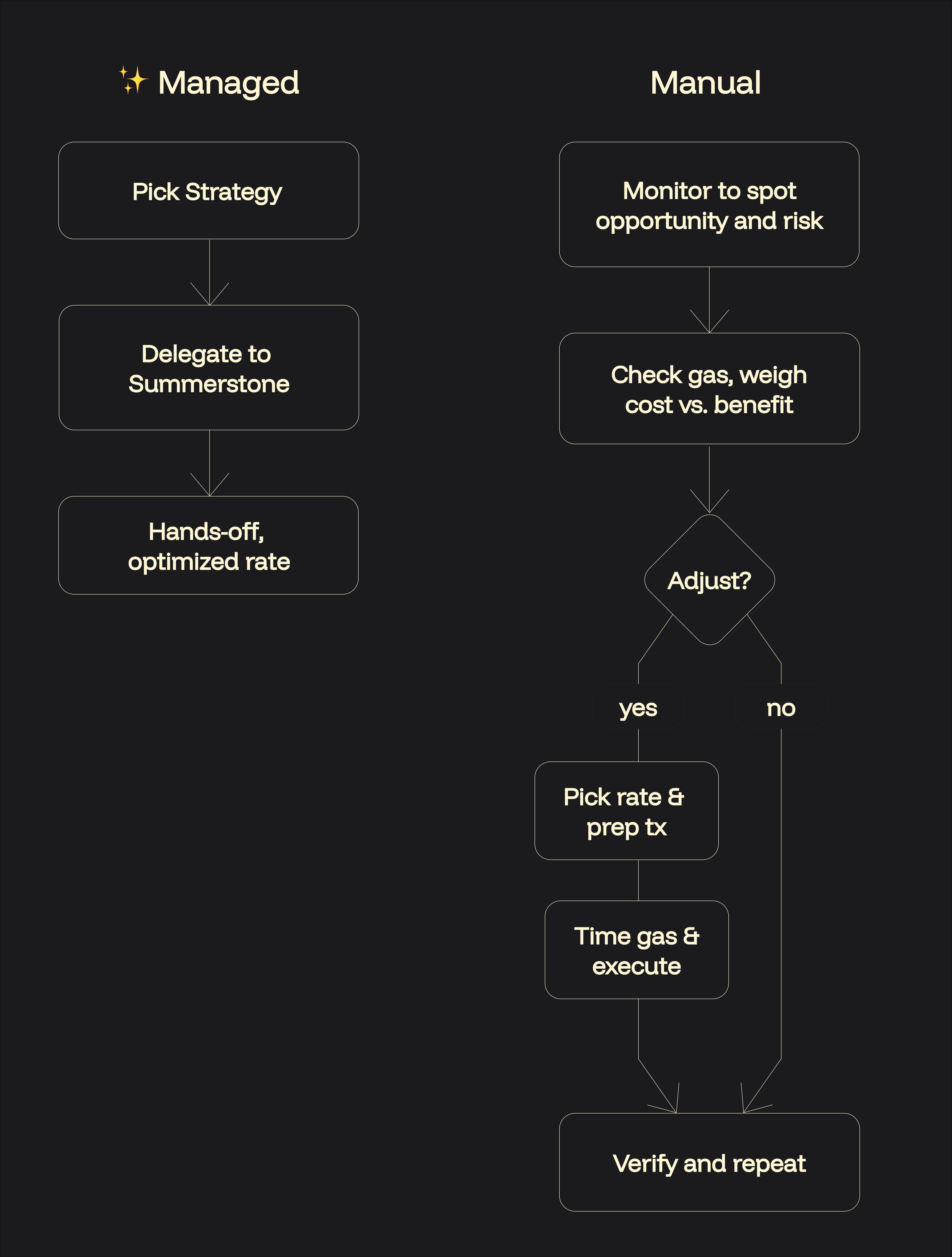
The following diagram compares Summerstone's automated approach to manual adjustments:
 ## Manual Adjustments: Hidden Costs and Risks
Adjusting your own interest rates may seem straightforward, but often involves significant unseen costs:
* **Gas Fees:** Frequent manual adjustments become costly quickly.
* **Redemption Risk:** Manual updates are often too late or suboptimal, increasing the risk of loan redemption.
* **Emotional Cost:** Constant anxiety and stressful emergency adjustments during market volatility.
* **Capital Inefficiency:** Overpaying interest due to delayed or missed adjustments.
## **Why Summerstone Rate Automation?**
Summerstone's automated interest rate strategies eliminate the burden of costs associated with manual adjustments, maximizing your capital efficiency and significantly reducing redemption risks:
* **Significant savings:** Automatically optimized interest rates can significantly lower your borrowing costs compared to manual adjustments.
* **Reduced gas costs to zero:** Automated adjustments save significant gas costs compared to frequent manual adjustments.
* **Optimized Interest Rates:** Our continuous monitoring and real-time adjustments lead to lower average interest rates. Manual updates are often too late or suboptimal, increasing costs and the risk of loan redemption.
* **Proactive risk reduction:** Our algorithm monitors market conditions around the clock, actively reducing user’s redemption risk.
* **User remains in control:** Delegate only the automation of your interest rate. Summerstone can never take custody or control of your funds.
* **Trusted expertise:** As long-term partners of Liquity AG, we leverage deep expertise in blockchain analytics and operational excellence.
# Summerstone Brand Kit (https://summerstone.xyz/docs/brand-kit.md)
This section includes logos, wordmarks, colors and fonts.
## Brand Colors
* **Carrot orange**: #FA970B
* **Eerie black**: #222020
* **Corn silk**: #FEF6D5
## Fonts
* **Titles**: Funnel Display
* **Content**: Funnel Sans
## Download our Brand Kit
Download the [Summerstone Brand Kit](/files/Summerstone_Brand_Kit.zip).
# Blog (https://summerstone.xyz/blog.md)
Announcements and updates from the Summerstone team.
## Posts
- [Summerstone extends rate automation to Mustang](https://summerstone.xyz/blog/summerstone-and-mustang.md): Summerstone is extending rate automation services to Saga's native stablecoin MUST.
- [Summerstone partners with Nerite](https://summerstone.xyz/blog/summerstone-and-nerite.md): As part of our wider commitment to the Liquity ecosystem, Summerstone is partnering with Nerite to make the future of borrowing a reality on Arbitrum One.
# Summerstone extends rate automation to Mustang (https://summerstone.xyz/blog/summerstone-and-mustang.md)
Summerstone is extending rate automation services to Saga's native stablecoin MUST.
## Mustang Finance & MUST, built for Saga
Mustang Finance is bringing [Liquity V2](https://liquity.org/)-based borrowing to Saga EVM. Through the CDP, Saga users can mint the stablecoin MUST, with a rock-solid USD peg.
The MUST stablecoin can be minted by depositing one of seven types of collateral: WETH, yETH, tBTC, wSAGA, wstAtom, KING and yUSD. Once deposited, users can open a trove setting their own interest rates without relying on governance or on any specific algorithm.
## Manual Adjustments: Hidden Costs and Risks
Adjusting your own interest rates may seem straightforward, but often involves significant unseen costs:
* **Gas Fees:** Frequent manual adjustments become costly quickly.
* **Redemption Risk:** Manual updates are often too late or suboptimal, increasing the risk of loan redemption.
* **Emotional Cost:** Constant anxiety and stressful emergency adjustments during market volatility.
* **Capital Inefficiency:** Overpaying interest due to delayed or missed adjustments.
## **Why Summerstone Rate Automation?**
Summerstone's automated interest rate strategies eliminate the burden of costs associated with manual adjustments, maximizing your capital efficiency and significantly reducing redemption risks:
* **Significant savings:** Automatically optimized interest rates can significantly lower your borrowing costs compared to manual adjustments.
* **Reduced gas costs to zero:** Automated adjustments save significant gas costs compared to frequent manual adjustments.
* **Optimized Interest Rates:** Our continuous monitoring and real-time adjustments lead to lower average interest rates. Manual updates are often too late or suboptimal, increasing costs and the risk of loan redemption.
* **Proactive risk reduction:** Our algorithm monitors market conditions around the clock, actively reducing user’s redemption risk.
* **User remains in control:** Delegate only the automation of your interest rate. Summerstone can never take custody or control of your funds.
* **Trusted expertise:** As long-term partners of Liquity AG, we leverage deep expertise in blockchain analytics and operational excellence.
# Summerstone Brand Kit (https://summerstone.xyz/docs/brand-kit.md)
This section includes logos, wordmarks, colors and fonts.
## Brand Colors
* **Carrot orange**: #FA970B
* **Eerie black**: #222020
* **Corn silk**: #FEF6D5
## Fonts
* **Titles**: Funnel Display
* **Content**: Funnel Sans
## Download our Brand Kit
Download the [Summerstone Brand Kit](/files/Summerstone_Brand_Kit.zip).
# Blog (https://summerstone.xyz/blog.md)
Announcements and updates from the Summerstone team.
## Posts
- [Summerstone extends rate automation to Mustang](https://summerstone.xyz/blog/summerstone-and-mustang.md): Summerstone is extending rate automation services to Saga's native stablecoin MUST.
- [Summerstone partners with Nerite](https://summerstone.xyz/blog/summerstone-and-nerite.md): As part of our wider commitment to the Liquity ecosystem, Summerstone is partnering with Nerite to make the future of borrowing a reality on Arbitrum One.
# Summerstone extends rate automation to Mustang (https://summerstone.xyz/blog/summerstone-and-mustang.md)
Summerstone is extending rate automation services to Saga's native stablecoin MUST.
## Mustang Finance & MUST, built for Saga
Mustang Finance is bringing [Liquity V2](https://liquity.org/)-based borrowing to Saga EVM. Through the CDP, Saga users can mint the stablecoin MUST, with a rock-solid USD peg.
The MUST stablecoin can be minted by depositing one of seven types of collateral: WETH, yETH, tBTC, wSAGA, wstAtom, KING and yUSD. Once deposited, users can open a trove setting their own interest rates without relying on governance or on any specific algorithm.
## How can Saga Users Benefit from Summerstone
Summerstone aligns with user's, reducing their overall borrowing costs through calculating precise, reliable rates.
We do so by:
→ **24/7 monitoring:** Our solvers monitor all troves, system parameters, market conditions and outside debt to have a holistic view of the system's status.
→ **Optimized rate tuning**: We spread out the amount of changes and keep borrowing costs as low as possible while protecting against redemptions, the automatic peg-stabilization mechanism used by Mustang Finance.
At any point, our solvers are prepared to trigger rate adjustments of our automated troves.
## Get started using Summerstone interest rate strategies on Mustang
1. Head to [app.must.finance](https://apps.must.finance/) and connect your wallet.
2. Pick your collateral, and amount to borrow.
3. Set your interest rate as "Delegated" and pick the Strategy Delegate Address of your chosen collateral from the [Summerstone Docs](https://summerstone.xyz/docs/borrowing/supported-protocols/must-and-mustang).
Alternatively, you can try out the [Summerstone Wizard 🧙♂️](https://ir-wizard.summerstone.xyz/): a new interface to delegate rate automation of your Liquity-based loans. All in one place. We currently support Liquity, Mustang Finance, Nerite, Soneta.
Read more about Mustang on [docs.must.finance](https://docs.must.finance/)
# Summerstone partners with Nerite (https://summerstone.xyz/blog/summerstone-and-nerite.md)
As part of our wider commitment to the Liquity ecosystem, Summerstone is partnering with Nerite to make the future of borrowing a reality on Arbitrum One.
## Nerite & USND, built specifically for Arbitrum
[Nerite](https://nerite.org/) is a [Liquity V2](https://liquity.org/)-based borrowing protocol. It inherits the protocol’s immutability while letting users mint USND, Nerite’s native USD-pegged stablecoin.
In Nerite, borrowers can establish their own interest rates, according to what they are willing to pay without relying on governance or a protocol-set algorithm rates.
### Nerite expands Liquity’s model
→ **Broader collateral:** In addition to ETH, wstETH, and rETH, Nerite accepts rsETH, weETH, ARB, COMP, and tBTC.
→ **Streamable stablecoin**: USND, is issued as a [Superfluid super token](https://docs.superfluid.org/docs/concepts/superfluid#super-tokens), allowing value to flow continuously rather than by discrete transfers.
→ **Lower entry:** Minimum debt per borrow on Nerite is 500 USND, one quarter the Liquity V2 baseline, opening the door to smaller positions.
## Powering market operations for Nerite
Market operations becomes increasingly important to guarantee the stability of USD-pegged tokens, especially when backed by diverse sets of liquid staking derivatives and non ETH assets.
Summerstone will continuously map Nerite’s market conditions. Powered by real time data, Summerstone’s interest rate solvers and liquidation engine are prepared to trigger interest rate adjustments and precise liquidations across every supported collateral, adapting to each specific liquidity profile and volatility.
As with Liquity V2, Nerite borrowers will be able to delegate their interest rate automation to Summerstone.
### How this benefits users
→ **Reliable rates.** Interest bands tuned for market depth rather than rough averages with reliable data.
→ **Predictable peg behaviour**, creating the basis for a sustainable market.
→ **Trusted Manager.** Users can delegate changes to their interest rates to a long-standing, reputable member of the Liquity and Nerite ecosystems.
## Get Started
Nerite opens the door to user-set interest rates on Arbitrum. Summerstone supplies rate engineering, and data monitoring. By working side-by-side, we aim to set a new standard for self-custodial borrowing on Arbiturm.
Get started on [nerite.org](https://nerite.org/)
To get in touch, [reach out to us](https://graphops.notion.site/32e2931a55f7814bbea2edfe9481579d?pvs=105).
# Research (https://summerstone.xyz/research.md)
Research and publications from the Summerstone team.
## Posts
- [Pendle as Yield Infrastructure](https://summerstone.xyz/research/pendle.md): How the venue works, and how lending protocols shape its markets.
- [Morpho curators: market structure in 2025](https://summerstone.xyz/research/morpho-curators-market-structure-january-2026.md): A look into liquidity, curator consolidation, their supply, and the stablecoin landscape in Morpho.
- [Liquity V2 Batch Managers: ICP-Based vs Summerstone](https://summerstone.xyz/research/liquity-v2-rate-managers.md): This article outlines how ICP-based batch managers differ from Summerstone's approach.
# Pendle as Yield Infrastructure (https://summerstone.xyz/research/pendle.md)
How the venue works, and how lending protocols shape its markets.
## Summary
In 2025, Pendle shifted from a general yield-tokenization protocol into infrastructure for locking stablecoin yields at fixed rates. ETH derivatives, once Pendle's core use case, declined to just 2.9% of open interest. Activity consolidated around a narrow set of stablecoin instruments where implied rates trade persistently at 8–20%, well above ETH derivative yields of 3–7%.
Users overwhelmingly buy and hold. 85.6% of capital stays until maturity, 98.9% of wallets never sell, and only 7.4% of expired capital rolls into the next expiry. Pendle operates as a one-way funding lock rather than a trading venue.
But this capital doesn't arrive directly. 73.8% of Pendle's external PT open interest flows through lending protocol intermediaries: Aave V3 alone holds 54.7% across 26 vault contracts. The dominant strategy is looping yield-bearing stablecoins: deposit into Pendle, post PT as collateral on a lending venue, borrow stablecoins, re-enter Pendle. This makes Pendle's scale inseparable from the lending venues that consume its output, and inflates headline open interest.
### Key findings:
* $538M in active PT open interest, with 96.1% in stablecoins.
* About 66-day weighted average duration: the average dollar on Pendle is exposed to rate moves for roughly two months. Pendle is short-duration yield infrastructure, not a term funding venue.
* 93% of dollar-denominated OI in holding-behavior markets: positions are sticky, not churning.
* 54.7% of all PT units are held by Aave V3: Pendle is an intermediary-consumed infrastructure and integrated directly with lending venues, not a direct-to-user venue.
* We estimate 10–31% of OI is leverage-generated rather than independently committed capital.
* Only 7.4% of expired capital rolls into the next expiry. When PT positions expire without rollover, the associated lending positions (loops, collateral commitments) must also unwind, creating periodic deleveraging pressure across the lending venues that warehouse PT.
* 66.1% of outstanding YT sits with addresses that only ever minted (PT-motivated), while just 15.5% represents independent yield-long demand. The yield side of Pendle is largely a byproduct of principal token manufacturing, not the primary product.
## What Pendle Is
Pendle is infrastructure for separating, pricing, and transferring future yield. It tokenizes yield that originates elsewhere. Pendle takes yield-bearing assets and splits them into their principal and yield components, each tradeable independently through a dedicated AMM. Through the venue participants can lock fixed rates, trade yield exposure, or hold positions until maturity.
The mechanism begins with [Standardized Yield (SY)](https://docs.pendle.finance/pendle-v2/ProtocolMechanics/YieldTokenization/SY), a token wrapper conforming to [EIP-5115](https://eips.ethereum.org/EIPS/eip-5115) that provides a common interface for any yield-bearing asset and standardizes how Pendle interacts with the full range of yield-bearing assets across DeFi. When a token is deposited into Pendle, it is first wrapped into its SY representation (e.g., sUSDe becomes SY-sUSDe).
SY is then split into two tokens in equal quantities: a Principal Token (PT) and a Yield Token (YT). The split is atomic: 1 SY always produces 1 PT and 1 YT, and the [two cannot be created independently.](https://docs.pendle.finance/pendle-v2/Developers/HighLevelArchitecture)
* A [Principal Token](https://docs.pendle.finance/pendle-v2/ProtocolMechanics/YieldTokenization/PT) is a claim on the underlying principal at maturity. PT trades at a discount to its underlying asset, and that discount narrows as maturity approaches, converging toward par at expiry. This predictable price path is what makes PT function as collateral on external lending venues, a dynamic central to how Pendle's open interest is consumed downstream.
* A [Yield Token](https://docs.pendle.finance/pendle-v2/ProtocolMechanics/YieldTokenization/YT) is a claim on all yield generated by the underlying from the point of acquisition until maturity. YT holders can claim accrued yield at any time. At expiry, YT's value converges to zero: whatever yield was generated has been captured, and the token carries no residual claim. After maturity, only PT is required to redeem the underlying.
Each underlying asset can support multiple Pendle markets at different maturities, each with its own liquidity pool and its own implied rate. Trading occurs through a single PT/SY liquidity pool per market. The [AMM is time-aware](https://docs.pendle.finance/pendle-v2/ProtocolMechanics/LiquidityEngines/AMM): its curve shifts to account for PT's natural price appreciation as maturity approaches, concentrating liquidity around expected yield ranges and reducing impermanent loss for liquidity providers. YT trades route through the same pool via flash swaps. A single pool serves both sides of the yield split.
## SY-Notional in 2025: Activity & Composition
SY-notional captures the priced economic throughput flowing through Pendle's V3 markets: the daily volume of Standardized Yield tokens repriced via the AMM, representing how much yield exposure changes hands.
* For most of 2025, daily swaps ranged 500–2,000 with trader counts tracking closely. Activity spiked sharply in early November: daily swaps exceeded [9,400 and unique traders hit 8,000.](https://dune.com/queries/6523115/10329644)
* Late-2025 throughput was dominated by [Hyperlend](https://dune.com/queries/6530486/10329737), [Ethena (USDe/sUSDe), Resolv, Open Dollar](https://dune.com/queries/6546841/10350401) – almost entirely stablecoin-sourced. ETH-derivative swap activity concentrated in H1 2025 and became minimal after June.
### ETH-Derivative Throughput
SY-notional across a whitelist of ETH-derivative underlyings (weETH, pufETH, rsETH, rswETH, tETH) shows extreme sparsity punctuated by episodic spikes.
[Q1 throughput totaled $90.4M, growing to $116.1M in Q2 before collapsing post-June to $16.2M in Q3](https://dune.com/queries/6529731/10329443). The decline is more severe than USD figures suggest: ETH rallied from \~$2,800 to a $4,900 ATH in late August, meaning constant activity levels would have produced *higher* Q3 volumes, not lower. The USD-denominated drop understates the real contraction in ETH-notional terms.
PT-notional for the same ETH-derivatives shows expiry-driven spikes in late May and June, likely tied to duration compression and roll/unwind events. Outside these episodes, PT-notional is minimal, consistent with steady-state rolling rather than active rate trading.
## Open Interest
Open interest measures total Principal Tokens outstanding: capital committed to fixed-rate positions that hasn't expired or been redeemed. Where SY-notional and PT-notional measure flow (what passed through), OI measures stock (what stayed).
Three lenses apply: PT OI in units (principal committed), PT OI in USD (dollar value of commitments, requiring pricing), and duration outstanding (PT OI × time-to-maturity, yielding rate-dollar-years of risk in the system).
### Unit-Denominated Open Interest: Scale & Concentration
**Scale & Concentration**
Aggregate active PT OI stands at [538M units across 96 unexpired markets](https://dune.com/queries/6569097/10378004). Concentration of current active markets is extreme: the [top 5 markets hold 80% of OI, the top 10 hold 95%](https://dune.com/queries/6569097/10378004).
The [leading markets](https://dune.com/queries/6569097/10378004) (PT-sUSDe-7MAY2026 (41.8%), PT-srUSDe-2APR2026 (15.4%), PT-sNUSD-5MAR2026 (13.8%)) reflect the current expiry cycle with asset concentration around the Ethena ecosystem and Strata's yield products (sUSDe, srUSDe, USDe, sENA, jrUSDe collectively \~65% of active OI).
This is contingent on current market preferences in this particular window of time and could shift with subsequent expiry cycles. Active markets vary greatly as throughout compiling this report some have expired.
**Temporal Concentration**
Temporal concentration in Pendle markets is structural, reflecting how yield markets work:
* Lifecycle accumulation: older markets have had more time to build OI
* Capital efficiency: traders prefer shorter lockups
* Price certainty: PT converges to par at expiry
* Roll behavior: traders exit and roll into next maturity
Unlike asset concentration (which is contingent), the preference for sub-90-day maturities is structural: PT buyers prefer shorter duration locks for capital efficiency and price certainty (PT converges to par at expiry, reducing mark-to-market risk).
The bulk of active OI sits in the 30–90 day bucket (58%), followed by 0–30 days (14.4%). The 180+ day bucket is essentially empty. This mid-curve concentration reflects the current expiry calendar: the March through May 2026 cluster carries the majority of commitments.
**Asset Composition**
* Stablecoin dominance is total across all buckets. ETH-derivative categories (eETH, stETH, Other ETH) are essentially minimal beyond the 0-30 day bucket.
* Different stablecoins [dominate different parts of the curve](https://dune.com/queries/6571180/10380702):
* 0–30 days: NUSD (Neutrl) at 92.9%, reflecting near-term maturity concentration in a single issuer
* 30–90 days: Ethena ecosystem at 97.7% (USDe variants 90.9% and other non-stablecoin assets like sENA 6.9%), representing the core of Pendle's current OI.
* 90–180 days: cUSD (Cap) at 57.7%, with a broader mix including other USD-denominated positions (28.8%) and a smaller Ethena share (6.9%)
### Dollar denominated PT Open Interest
Pricing PT open interest quantifies warehoused funding commitments on Pendle in economic terms. Active dollar-denominated OI stands at $538M across 45 priced markets.
* [Stablecoins account for 96.1% ($517M), ETH derivatives 2.9% ($15.7M), and other assets 1.0%.](https://dune.com/queries/6681180/10522583) The stablecoin dominance observed in unit terms carries through to dollar terms without distortion
* The pricing confidence breakdown for stablecoins: [47% carries direct observable swap prices, 16% relies on the $1 peg assumption, and 37% uses manual estimates](https://dune.com/queries/6681180/10522583) (primarily for yield-bearing wrappers like sUSDe).
### Duration outstanding
Duration outstanding measures total rate sensitivity in Pendle's positions. It's the answer to "if yields move by 1%, how many dollar-years of exposure are affected?"
* Total duration outstanding is [98.9M rate-dollar-years against $546M in OI](https://dune.com/queries/6576943/10388364)
* The weighted average duration is [0.18 years (66 days)](https://dune.com/queries/6576943/10388364), meaning the average dollar on Pendle is exposed to rate moves for roughly two months.
* The [distribution across duration buckets reveals a proportional relationship between capital and risk](https://dune.com/queries/6576901/10388351):
* The majority of capital (70.4%) sits in 30–90 day positions, and those positions carry a roughly proportional share of duration risk (67.2%). This is centered on the March–May 2026 expiry cluster.
* Near-maturity positions (\<30 days) hold 17.3% of OI but contribute only 7.5% of duration risk. The mild inversion appears at the long end: the 12.4% of OI in >90 day positions contributes 25.4% of duration risk.
Pendle functions as a short-to-medium duration venue, not a long-duration funding warehouse. The 66-day weighted average duration, combined with high OI, indicates positioning around specific expiry cycles rather than extended rate commitments.
### OI/Turnover Ratio
Does Pendle's $538M in active OI sit or churn? Dividing each market's outstanding PT by its 30-day PT-notional traded produces a stickiness ratio that can tell us how many months of current turnover it would take to cycle through the entire position.
* The [seven largest markets](https://dune.com/queries/6576969/10388417?sidebar=none) (PT-sUSDe-7MAY2026, PT-reUSD-25JUN2026, PT-srUSDe-2APR2026, PT-sNUSD-5MAR2026, PT-sENA-30APR2026, PT-USDe-7MAY2026, and PT-stcUSD-23JUL2026) collectively hold $529M and all classify as high-stickiness warehousing (ratio >2x).
* PT-sUSDe sits at 107x, meaning its entire 30-day trading volume would need to repeat over a hundred times to equal the outstanding position. PT-USDe shows 60x.
* Even the "lower" ratios in this group – srUSDe at 5.0x, sNUSD at 3.6x – imply positions measured in months of turnover, not days.
* A handful of mid-sized markets (PT-jrUSDe at $15.7M, PT-savUSD at $13.7M, PT-cUSD at $8.1M) show [moderate stickiness with ratios near 1.0–1.6x](https://dune.com/queries/6576969/10388417?sidebar=none), where some active positioning coexists with warehousing.
No market with meaningful OI classifies as an active trading venue. [Roughly 93% of dollar-denominated OI sits in warehousing-behavior markets](https://dune.com/queries/6576969/10388417?sidebar=none). Capital enters, locks a rate, and holds to maturity. The turnover observed is consistent with marginal rebalancing and new entry, not active rate trading or position rotation.
## Implied Rate Curve
The implied rate is the annualized yield embedded in Pendle's Principal Token (PT) prices. When a PT trades at a discount to its underlying SY token, that discount implies a yield to maturity. This curve represents the market-priced cost of future yield across different maturities within Pendle, emerging from the AMM pricing of PTs relative to their underlying assets.
Average implied rate across all active Pendle markets, grouped by asset class shows us:
* [Stablecoin yields trade at 8-20%, while ETH derivatives remain anchored at 3-7%](https://dune.com/queries/6608555/10430811). This percentage point spread persisted throughout 2025. Note that stablecoin PT rates approximate total return, while ETH derivative PT rates compensate only for yield, the holder also carries the underlying's price risk. The gap reflects different risk compositions, not a simple premium.
* ETH derivatives show less volatility than stablecoin yield as a combined asset class.
An important structural note on maturity design: Pendle does not create short-tenor products. Of 182 historical stablecoin markets, 53% were designed with 91–180 day tenors and only 4% with sub-30 day tenors. ETH derivatives skew even longer – no sub-30 day product has ever existed, and 18% of ETH markets carry 365d+ tenors. This means that when short-dated rates appear in the data, they represent aging products approaching expiry, not purpose-built short-term funding instruments. Stablecoin markets are expanding into longer duration, with the 181–365 day bucket showing 16 active versus only 5 expired markets.
### Popular Products by Open Interest
To understand which products drive aggregate rate behavior, we examined implied rates for markets where capital is actually committed.
* Ranking products by current open interest shows the top 10 products by OI are mostly stablecoin-adjacent, no ETH derivative appears. SY-sUSDE leads at $220.6M, followed by SY-reUSD ($85.5M), SY-srUSDe ($81.5M), and SY-sNUSD ($71.3M).
* SY-sENA's ($25.2M OI) average rate of 25.82% with a CV of 34.9% represents a fundamentally different yield profile from core stablecoin funding products.
* Several of the top-10 products (reUSD, jrUSDe, srUSDe, NUSD) only launched mid-2025, meaning their yield statistics cover a shorter observation window than full-year products like sUSDE or USDe.
* High open interest does not imply stable yields. To assess yield predictability, we computed the coefficient of variation for each product, the ratio of rate volatility (standard deviation) to average rate. This normalizes volatility across different yield levels.
* The largest products show wide dispersion in yield stability: SY-sUSDE and SY-USDe exhibit [CV percentages of 43–44.6%](https://dune.com/queries/6609311/10431859), meaning nearly half the average rate level is consumed by volatility.
* By contrast, products like [SY-jrUSDe (CV 12.8%) and SY-NUSD (CV 18%)](https://dune.com/queries/6609311/10431859) offer meaningfully tighter yield predictability.
### Yields: Stablecoin vs. ETH Derivatives
* Within asset class, products move directionally similar. The two asset classes are presented to characterize each rate regime independently. Cross-class rate comparisons do not reflect risk-adjusted relative value.
* In stablecoins:
* Ethena products (sUSDE, USDe) are the only two with full-year coverage, compressing from \~20–23% in January. sUSDE stabilized around 8–10% while USDe drifted to 3–5% by year-end.
* srUSDe, sNUSD, reUSD, stcUSD arrived into a lower-rate environment and traded in the 8–15% range. reUSD stands out as the most volatile of the group, spiking to 20% around July. sNUSD and srUSDe held relatively tighter bands in the 8–13% range.
* stcUSD (Cap) traded the narrowest band of the six until a sharp drop around October, consistent with its low CV of 22.1%.
* ETH-based products cluster around 2–5% with two notable exceptions: SY-tETH spiked to 17% in February and 20% in June 2025. Outside these spikes, ETH products on Pendle offer lower but more predictable fixed yields.
## User Behavior and Capital Concentration on Pendle
This section provides a snapshot of the current state of Pendle, capturing who holds what now and how they behaved up to this point, rather than tracking how these distributions evolved over time.
### Hold-to-Maturity Behaviour
* Across all markets with >1M units of open interest (approximately equivalent to >$1M for stablecoin markets), [85.6% of capital acquired via swaps is held toward maturity](https://dune.com/queries/6617576/10442217). This aligns with the OI/Turnover stickiness ratio: Pendle functions as a funding lock venue where participants acquire PT positions.
* Wallet-level passivity is extreme: [98.9% of buyer wallets never sell](https://dune.com/queries/6617576/10442206) any portion of their position prior to maturity. Early exits are driven by roughly 1% of participants, likely active managers or LPs rebalancing positions.
* Hold rates show no meaningful correlation with market size. [Markets ranging from $3M to $225M OI cluster between 80-100% hold rates, with no systematic decline at larger scale](https://dune.com/queries/6617384/10442139).
* Similarly, time-to-maturity does not materially affect exit behavior. Whether a market has 20 days or 160 days to expiry, hold rates remain clustered between 72-99.6%, with one [outlier market (sYUSD) at 41%](https://dune.com/queries/6617384/10441995).
### Rollover
Rollover analysis examines whether demand for Pendle yield exposure is persistent or episodic. A high rollover rate would indicate wallets systematically re-entering after expiry, demand from participants for the same markets. A low rollover rate suggests one-time tactical positioning.
* Venue-wide swap-based acquisition rollover stands at [7.4%](https://dune.com/queries/6621778/10447159) across $819.3M in expired capital. Only $60.7M (7.4%) that held expired PT positions re-entered the same protocol's next market by expiry. Pendle currently tends to operate primarily as a single-cycle funding lock.
* Variance by market is significant. Rollover rates range from 0.1% (Cap) to 16.4% (Ethena). Ethena's rollover rate accounts for $44.5M in venue-wide rollover capital, while protocols with substantial expired capital bases – Cap at $216.7M, OpenEden at $117.2M – show rollover rates below 1.5%.
* [Only Ethena (16.4%) and Infinifi (13.2%)](https://dune.com/queries/6622157) show rollover behavior consistent with repeat structural use.
The low venue-wide rollover rate has implications for the lending venues that warehouse PT collateral. When PT positions expire without rollover, the associated lending positions – loops, collateral pledges – must also unwind.
### Capital Concentration by Holder Type
Open interest at the wallet level gives us a general idea of who holds Pendle's duration commitments. The distribution indicates whether Pendle serves as infrastructure for retail users or indicates sophisticated use and allocators.
* Pendle is not a direct-to-user venue. Only [20% of total PT OI sits with EOAs interacting with Pendle directly (181M units across 4,079 wallets, excluding Pendle infrastructure)](https://dune.com/queries/6681756).
* The dominant access point is lending protocol integration. Aave, Morpho, Euler, and Silo collectively hold [66.1% of total PT OI (73.8% of external OI) across 76 contracts](https://dune.com/queries/6681756), each aggregating potentially thousands of underlying depositors.
* Aave remains the primary channel: [26 contracts holding 54.7% of total PT OI (552M units)](https://dune.com/queries/6681756). Morpho adds 10.4% (104M units) across just 2 vault contracts. Combined, these two protocols represent 65% of total warehoused capital. Euler (0.8%) and Silo (0.2%) contribute at the margin.
* Multisigs represent 4.2% of OI. This can suggest treasury management or institutional allocations accessing Pendle directly rather than through lending aggregators.
* Wallet counts create an illusion of breadth. The 4079 EOAs sound like broad participation, but they hold only [18% of total units](https://dune.com/queries/6681756). The 76 lending vault contracts holding 66% are the economically significant participants.
* Among direct EOA holders capital concentration remains very high: Gini coefficient of [0.916](https://dune.com/queries/6681766). Pendle attracts concentrated capital both through aggregated lending protocol exposure and among direct participants. The venue does not exhibit broad retail dispersion. Including multisig wallets alongside EOAs produces a near-identical Gini of [0.917](https://dune.com/queries/6681766).
### Holder Composition Across Asset Classes
* Lending protocol integration of Pendle is entirely a stablecoin and "other" asset phenomenon. No lending protocol holds net PT positions in ETH derivatives. [Stablecoin PT is 77.9% Aave, 7.9% Morpho, and only 10.3% EOA](https://dune.com/queries/6623264/10449099). ETH-derivative PT is held entirely by EOA.
* Within lending protocols, asset specialization is pronounced.
* Aave V3 holds 535M units, of which [78.6% is stablecoin and 21.4% "other."](https://dune.com/queries/6623325)
* Morpho holds [61% "other" and 39% stablecoin.](https://dune.com/queries/6623325) The other category includes assets like ENA, CRV, and governance-adjacent tokens and routes disproportionately through Morpho and Euler rather than Aave.
* [Other also carries 3.5% in unclassified contracts](https://dune.com/queries/6623264/10449099), likely specialized vaults or strategy contracts outside of our coverage.
## Yield Tokens: The Other Side of the Split
Every PT minted on Pendle produces a YT as its mechanical counterpart. The split is atomic: 1 SY deposited yields 1 PT and 1 YT and the two cannot be created independently. Total outstanding supply of each is comparable across active markets. But where they end up is entirely different.
* Across 15 active markets with more than 1M units in PT outstanding, YT balances sit almost entirely in individual wallets. [In 12 of 15 markets, more than 93% of YT is held by EOAs.](https://dune.com/queries/6681863/10523619) The three exceptions – sUSDE (76.6%), iUSD (82.7%), and siUSD (53.8%) – show the remainder in non-lending smart contracts that custody YT on behalf of depositors.
* No yield tokens sit in lending protocol contracts across all 15 active markets. By contrast, PT distribution varies dramatically depending on whether the underlying has been accepted as collateral on a lending venue. PTs that have been onboarded [59–99% of PT outstanding sits in lending protocol contracts, with the highest concentration in USDe (99.5%) and srUSDe (95.3%).](https://dune.com/queries/6681863/10523619)
When a participant splits SY to post PT as collateral on Aave or Morpho, the PT moves into a lending contract. The YT stays in the minter's wallet or is sold to another individual on the secondary market.
In principle, buying YT is a directional bet on yield: a participant who believes realized yield will exceed the rate implied by current PT pricing can buy YT and profit from the difference. [YT offers capital-efficient exposure because its price reflects only the yield component, creating leveraged exposure without margin or liquidation risk.](http://docs.pendle.finance/ProtocolMechanics/LiquidityEngines/AMM) We can classify current YT holders by acquisition history: only received YT from the zero address (a mint) versus only from other addresses (secondary market acquisition).
[Stablecoin YT across current Ethereum active markets accounts for approximately 524M units across 2,261 holders:](https://dune.com/queries/6676820)
* 66.1% sits with addresses that only ever received YT through minting. This is consistent with the interpretation that the dominant flow is PT-motivated, where YT remains as a byproduct.
* 18.4% with addresses that both minted and subsequently acquired additional YT through secondary markets. These are addresses that manufactured the split, but also came back to increase yield exposure.
* 15.5% with addresses that never minted at all. This represents genuine yield-long demand from participants who went to Pendle specifically to acquire yield exposure without ever manufacturing the split themselves.
The majority of YT is downstream of PT manufacturing. But a meaningful minority (1/3) reflects independent or reinforced yield-long positioning.
The absence of YT from lending protocol collateral markets reflects structural incompatibility with how lending venues assess collateral. PT's collateral profile converges to par at maturity, allowing lending protocols to set high LTVs. YT decays to zero at maturity and collateral value deteriorates over time regardless of market conditions. In cases where the underlying asset experiences losses, YT absorbs those losses first and can theoretically become negative in value. A lending protocol accepting YT as collateral would require either aggressive LTVs that make borrowing uneconomical or continuous monitoring. And while YT trades through the same AMM pool via flash swaps, the execution path is more complex, involving mint/redeem operations alongside swaps, and liquidation of a decaying asset at a predictable price remains harder than liquidating PT.
## PT Reuse Across Lending Venues
Pendle is part of the stack available to asset managers as a tool to offer higher APY for their vaults and serves users with the ability to acquire more units of an asset per dollar spent. Acquiring Principal Tokens means buying the underlying at a discount to par and locking a fixed rate for a defined period, forgoing the variable yield in exchange for price certainty. What makes this trade worthwhile depends on the underlying.
* For volatile assets, the discount can create a meaningful spread over alternatives. If a PT-stETH's implied yield exceeds the staking rate available, the buyer can capture the difference. This can also amplify if the underlying asset appreciates. A buyer with high conviction that a volatile asset will appreciate by maturity may prefer raw exposure over a predictable income stream, treating the PT as a discounted directional position.
* For stablecoins, the logic differs. The asset will not appreciate, so buying and holding stablecoin PTs delivers a better or worse rate than holding the underlying directly. The discount alone is not large enough to be a compelling strategy on its own. The only way to meaningfully amplify the fixed-rate return is through leverage.
Two observations emerge. First, in our venue analysis we observed ETH derivatives make up a small portion of Pendle's flows. The locked APY available for ETH derivatives does not create a meaningful spread over alternatives such as staking, generating little demand for PT-stETH and other ETH-linked products. Meanwhile, stablecoin rates are higher and capital deployed is far larger, making the fixed-rate locking decision more attractive. Second, because the dominant strategy for extracting value from stablecoins relies on looping, and we know Pendle's open interest is mostly concentrated on stablecoins: large parts of the OI could be reflexive. A portion of the capital warehoused in Pendle may itself have been generated by borrowing against previously warehoused Pendle positions.
## Looping with Pendle
Looping with Pendle works as follows: a participant deposits into Pendle to receive PT, posts that PT as collateral on a lending protocol, borrows stablecoins against it, and re-enters Pendle with the borrowed capital.
Why PTs? As maturity approaches, the discount shrinks toward zero and the collateral appreciates relative to the debt, meaning health factors on the loan improve over time. In stable market conditions, the loan becomes healthier as it ages. PT looping does not make a position liquidation-proof. It reduces liquidation risk compared to looping with volatile collateral like ETH, but the risk remains and arrives from several directions.
* Borrow rate spikes. If the lending protocol's borrow rate rises above the PT's locked-in yield, the loop becomes negative carry. Governance changes to LTV ratios, liquidation thresholds, or delisting of PT collateral markets can also break the loop entirely.
* Depegging of the underlying. A shallow depeg can be offset by the PT's gradual appreciation. However, a rapid depeg can push leveraged positions toward liquidation.
* PT liquidity within Pendle. Liquidity for a specific PT depends on LPs depositing PT and SY into that market's pool. Before maturity, unwinding depends on pool depth. Market stress can cause LPs to withdraw, and new pools with attractive incentives can pull liquidity away from existing markets, draining the exit path that leveraged holders depend on.
* Oracle and infrastructure risk. Oracle malfunction or compromise at any point in the asset stack can force unwinding regardless of position's health.
Participants building leveraged loops through Pendle have strong incentives to stay short-dated: less price sensitivity to yield spikes means less liquidation risk, less time for borrow rates to shift or governance changes to take effect, and faster access to capital for redeployment.
### Estimating Leverage Capacity
The yield routing originates in Pendle's AMM but executes entirely in external lending markets. The scope and parameters of available markets define the strategy's reach. Currently three venues are available on Ethereum: Aave, Morpho, and Euler.
* On Aave, two separate parameters govern leverage: Max LTV and Liquidation Threshold (LT), where Max LTV \< LT \< 1. Users can borrow up to LTV of their collateral value but are not liquidated until LT.
* On Morpho, a single parameter governs both: LLTV (Liquidation Loan-to-Value).
* On Euler, the deployer sets a borrowing LTV and a separate liquidation LTV for each vault-to-vault relationship.
We can estimate leverage capacity using available markets for each venue.
Venue: Aave
Market: [PT-sUSDe Stablecoins eMode](https://vote.onaave.com/proposal/?proposalId=299)
| Parameter | Value | Leverage at Threshold |
| --------------------- | ----- | --------------------- |
| Max LTV | 87.4% | 7.94x |
| Liquidation Threshold | 89.4% | 9.43x |
Market: [PT-srUSDe Stablecoins eMode](https://vote.onaave.com/proposal/?proposalId=444):
| Parameter | Value | Leverage at Threshold |
| --------------------- | ----- | --------------------- |
| Max LTV | 89.5% | 9.52x |
| Liquidation Threshold | 91.5% | 11.76x |
Market: [PT-srUSDe USDe eMode](https://vote.onaave.com/proposal/?proposalId=444):
| Parameter | Value | Leverage at Threshold |
| --------------------- | ----- | --------------------- |
| Max LTV | 91.2% | 11.36x |
| Liquidation Threshold | 93.2% | 14.71x |
Venue: Morpho
LLTV serves as both the maximum borrowing limit and the liquidation trigger. The following table shows achievable leverage with the mid-to-high [allow-list of permitted LLTV tiers](https://docs.morpho.org/curate/tutorials-market-v1/creating-market/#idle-markets).
| LLTV | Leverage at Threshold |
| ----- | --------------------- |
| 77.0% | 4.35x |
| 86.0% | 4.35x |
| 91.5% | 11.76x |
| 94.5% | 18.18x |
Currently, you can find markets along this range. [PT-sNUSD-5MAR2026/USDC](https://app.morpho.org/ethereum/market/0x2a9a5c436719badcfadbad3ad8e8179a160ded758603eaa03a883f922a1790d3/pt-snusd-5mar2026-usdc) lists an LLTV of 77% while some markets like [PT-stcUSD-23JUL2026/USDC](https://app.morpho.org/ethereum/market/0x2fb3713487c7812e7309935b034f40228841666f6b048faf31fd2110ae674f20/pt-stcusd-23jul2026-usdc) show an LLTV 91.5%.
Venue: Euler
LTV and LLTV values vary vault to vault, and Euler holds more borrow markets than Aave.
Market: [PT-jrUSDe / USDC](https://app.euler.finance/positions/0x2DA35f6e88Eaba4E705Bff7154B259859C353953/0xe0a80d35bB6618CBA260120b279d357978c42BCE?network=ethereum)
| Parameter | Value | Leverage at Threshold |
| --------------------- | ----- | --------------------- |
| Max LTV | 60% | 2.50x |
| Liquidation Threshold | 65% | 2.86x |
Market: [PT-srUSDe / USDC](https://app.euler.finance/positions/0x4f4Afcdd8E418f5AA9130BA53af23Cb7bf47F467/0xe0a80d35bB6618CBA260120b279d357978c42BCE?network=ethereum)
| Parameter | Value | Leverage at Threshold |
| --------------------- | ----- | --------------------- |
| Max LTV | 85% | 6.25x |
| Liquidation Threshold | 87% | 7.69x |
Market: [PT-srUSDe / borrow eUSDe](https://app.euler.finance/positions/0x4f4Afcdd8E418f5AA9130BA53af23Cb7bf47F467/0x61aAC438453d6e3513C0c8dbb69F13860E2B5028?network=ethereum)
| Parameter | Value | Leverage at Threshold |
| --------------------- | ----- | --------------------- |
| Max LTV | 90% | 10x |
| Liquidation Threshold | 92% | 12.5x |
For a more practical estimate, we can observe what leverage operating at 70% and 80% of the Liquidation Threshold achieves.
| Venue | Market | Liq. Threshold | 70% of LT | 80% of LT | Structural Max |
| ------ | -------------------------------------------------------------------------------------------------------------------------------------------------------------- | -------------- | ------------- | ------------- | -------------- |
| Euler | PT-jrUSDe / USDe | 65.0% | 45.5% / 1.83x | 52.0% / 2.08x | 2.86x |
| Morpho | [PT-sNUSD-5MAR2026/USDC](https://app.morpho.org/ethereum/market/0x2a9a5c436719badcfadbad3ad8e8179a160ded758603eaa03a883f922a1790d3/pt-snusd-5mar2026-usdc) | 77.0% | 53.9% / 2.17x | 61.6% / 2.60x | 7.14x |
| Euler | PT-srUSDe / USDC | 87.0% | 60.9% / 2.56x | 69.6% / 3.29x | 7.69x |
| Aave | PT-sUSDe Stablecoins | 89.4% | 62.6% / 2.67x | 71.5% / 3.51x | 9.43x |
| Morpho | [PT-stcUSD-23JUL2026/USDC](https://app.morpho.org/ethereum/market/0x2fb3713487c7812e7309935b034f40228841666f6b048faf31fd2110ae674f20/pt-stcusd-23jul2026-usdc) | 91.5% | 64.1% / 2.78x | 73.2% / 3.73x | 11.76x |
| Euler | PT-srUSDe / eUSDe | 92.0% | 64.4% / 2.81x | 73.6% / 3.79x | 12.50x |
Source: Leverage estimates computed from published liquidation thresholds on Aave, Morpho, and Euler as of February 2026
### Estimating the reflexive share of open interest
Not all PT open interest represents independent capital. Each looping iteration adds PT to the system without adding new external capital, inflating OI relative to the actual capital committed. 73.8% of PT held outside Pendle's own contracts sits in lending protocol addresses, approximately $356M of the $538M total OI. We cannot observe how much of it is actively collateralizing looped positions versus sitting as collateral for unrelated borrows, but we can bound the estimate.
We vary two assumptions: the share of lending-protocol PT that is actually looped (30%, 50%, 70%) and the leverage of those loops (2x, 3x). These are conservative estimates given the lending parameters documented in the previous section allow for greater leverage.
Taking the most conservative estimate, we assume 30% ($107M) is actively collateralizing looped positions. The remaining 70% ($249M) is either collateralizing unrelated borrows or not borrowed against at all. At 2x effective leverage, each dollar of original capital produces two dollars of PT through one full loop: $107M in looped PT was generated by $53M of original capital. Against total OI of $538M, that $53M in reflexive PT represents a 10% reflexive share. The independent capital actually committed to Pendle is $485M.
| Looping share | Leverage | Looped PT | Original capital | Reflexive PT | Reflexive share of total OI | Independent capital |
| ------------- | -------- | --------- | ---------------- | ------------ | --------------------------- | ------------------- |
| 30% | 2x | $107M | $53M | $53M | 10% | $485M |
| 50% | 2x | $178M | $89M | $89M | 17% | $449M |
| 70% | 2x | $249M | $125M | $125M | 23% | $413M |
| 30% | 3x | $107M | $36M | $71M | 13% | $467M |
| 50% | 3x | $178M | $59M | $119M | 22% | $419M |
| 70% | 3x | $249M | $83M | $166M | 31% | $372M |
Source: Scenario analysis based on onchain PT distribution across lending protocol addresses
The range spans 10-31%. Even the most conservative assumption (30% looped at 2x) implies roughly one in ten dollars of headline OI is leverage-generated. The aggressive end (70% at 3x) implies nearly one in three.
## Lending Venue Landscape
Available markets concentrate around a narrow set of venues and underlyings.
On Aave V3, PT collateral acceptance is narrow and concentrated in PT-sUSDe across two markets and, recently, PT-srUSDe. On Morpho, PT collateral markets are broader. Higher-deposit markets include Resupply's reUSD, Strata's srUSDe and jrUSDe, Cap's cUSD and stcUSD, Neutrl's NUSD, Resolv's RLP, Midas' mAPOLLO, InfiniFi's iUSD and siUSD, and Ethena's sUSDe. Most other PT collateral markets remain below $1M in deposits. On Euler, PT markets include Strata's srUSDe, jrUSDe, and pUSDe, Cap's cUSD and stcUSD, Falcon's USDf and sUSDf, sBOLD, Kelp DAO's hgETH, and Midas' mAPOLLO and mMEV.
### Who Controls What for Borrow Markets
#### Aave
PTs are not listed as general collateral but in a dedicated eMode category with specialized pricing. eMode are [groupings of correlated assets](https://community.chaoslabs.xyz/aave/risk/markets/Ethereum-main/e-mode) that hold the same category-specific oracles, stabilizing pricing within these groups and reducing unnecessary liquidations from minor price deviations. By allowing higher LTVs on correlated asset pairs, eMode enables the leveraged yield strategies that generate significantly more borrow demand than standard borrowing. Initial listings require governance proposals and follow a full governance cycle including onchain votes through [vote.onaave.com](http://vote.onaave.com/) (recent examples include [Strata's srUSDe](https://vote.onaave.com/proposal/?proposalId=444\&ipfsHash=0x4c5ae8b97620b88e0da6da0fde99dad21b121fac07165ac15b80c865da16bcae) and [PT Ethena May](https://vote.onaave.com/proposal/?proposalId=442\&ipfsHash=0xd996400425ba4dd6835d8abf7ee8db7519c9a21d40295cd9912035de2000178c)) Regardless of past acceptance, each new expiry requires explicit whitelisting.
LTV and risk parameters can be adjusted through the RiskSteward, which updates eMode collateral parameters such as Liquidation Threshold, LTV, and Liquidation Bonus within DAO-approved bounds, while also allowing changes to the discountRate of Pendle PT feeds. In practice, markets are whitelisted with recommended parameters and the RiskSteward adjusts as needed. As maturity approaches, the Edge AGRS system manages risk parameters; if the Pendle AMM reaches 96% PT liquidity concentration, LTV is set to zero and lending is paused.
Borrow rates are determined by the protocol's utilization-based kink model, governed at the DAO level.
PT supply as collateral is capped to reduce protocol exposure and manage concentration risk.
#### Morpho
Creating new borrow markets for any asset [in Morpho Blue markets is permissionless](https://docs.morpho.org/curate/tutorials-market-v1/creating-market/), requiring five parameters: loan token, collateral token, oracle, LLTV, and IRM.
LTV and risk parameters are immutable once created. Governance cannot modify them, though Morpho maintains an [allow-list of permitted LLTV tiers and IRM contracts](https://docs.morpho.org/curate/tutorials-market-v1/creating-market/#idle-markets). For PT collateral markets, the most commonly used tiers fall in the 86-94.5% range.
All markets currently use the same AdaptiveCurveIRM, which autonomously adjusts rates based on utilization targeting approximately 90%. No governance or curator can intervene in rate determination.
#### Euler
Every Euler Vault Kit (EVK) vault is simultaneously a deposit destination and a borrowing source. Unlike Morpho, there is no separate base-layer market underneath a vault layer, EVK unifies both functions. Anyone can list new markets.
LTV and risk parameters are set vault-to-vault, not asset-to-asset. The governor decides which collateral vaults to accept and assigns each a borrowing LTV and a separate liquidation LTV. Depending on vault type, parameters and borrow caps can be changed by the governor. Borrow rates are determined by an IRM contract attached to the vault; the governor selects the IRM and can change it.
### Collateral Selection and Underlying Risk
For non-yield-bearing underlyings such as USDe, NUSD, or cUSD, the PT still trades at a discount to par, but the discount does not compensate the holder for foregone yield, the underlying generates none. Instead, the YT side of these markets is priced almost entirely by points programs: Ethena's sats multipliers for USDe deposits on Pendle, Plasma's XPL program, and similar mechanisms.
For yield-bearing underlyings such as sUSDe or srUSDe, the PT embeds a genuine fixed-rate claim. The buyer foregoes variable yield in exchange for rate certainty over a defined period, and the resulting PT is the core substrate for the looping strategies documented in the previous sections. Even without points or multipliers, the spread creates demand.
Strata's srUSDe and jrUSDe represent a third category: a fixed-rate claim on the yield of another product. The underlying is itself a redistribution of Ethena's sUSDe strategy through Strata's tranche mechanism. The economic function is the same as the yield-bearing case, but the dependency chain between the PT holder and the original yield source is longer.
#### Supply-Side Selection
Across Aave, Morpho, and Euler, lending venue listings cluster around a narrow set of underlyings. Several structural filters operate simultaneously to consider which assets get listed on Aave and generate enough interest to be listed on Morpho and Euler.
* Redemption predictability is the first filter. Lending venues need confidence that PT-to-underlying conversion at maturity will execute reliably. The redemption path may depend on coverage ratio thresholds, minting pauses, or withdrawal queues. These dependencies make the underlying's stability over the PT's life the binding constraint.
* Collateral-debt correlation. When you borrow against collateral, the lending venue cares about how likely the collateral's value is to drop below your debt. The closer they move together, the lending venue can set a higher LTV without opening paths for unhealthy loans and leverage.
* Track record. Protocols that lack established history can route through permissionless venues like Morpho or Euler, where the curator layer performs the filtering function instead of full governance cycles.
* Liquidity depth in the Pendle AMM for that specific market. Liquidation of a PT collateral position requires selling PT into the pool. If a market is thin, the lending venue cannot rely on liquidation execution at reasonable prices. Duration of that specific market also determines exposure to risk. From the lending venue's perspective, shorter-dated PT markets are safer collateral.
#### Demand-Side Reinforcement
Two conditions channel demand toward specific underlyings.
* First, a yield spread over alternatives: the implied rate on the underlying persistently exceeds what a user can earn from holding directly.
* Second, reliable loopability: the Pendle market has depth, a lending venue accepts the PT with a high enough LTV to make the loop worthwhile, and the borrow market has sufficient liquidity to fund re-entry.
Strata's srUSDe listing illustrates the selection framework in action. The asset is stablecoin-denominated, so PT-srUSDe collateralizing a stablecoin borrow is a correlated pair. Redemption follows a defined path: srUSDe redeems to sUSDe, which redeems to USDe, with published coverage ratio thresholds governing each step. Liquidity depth is met through Pendle's AMM, where [97%+ of srUSDe supply sits in the SY-wrapper for PT markets](https://governance.aave.com/t/arfc-onboard-strata-srusde-pt-tokens-to-v3-core-instance/23481). Despite the protocol being live for four months, srUSDe markets have been used on Morpho and Euler, Strata has built reputation through it's [backing by the Ethena Foundation and investments by Anchorage Digital Ventures](https://www.coindesk.com/business/2025/12/16/strata-protocol-developer-frontera-labs-raises-usd3-million-in-seed-round). From the demand side, the implied rate and LTVs in Aave make increasing leverage attractive.
Pendle's scale cannot be read independently of the downstream lending venues and their parameter decisions that determine what gets listed, leveraged, and looped. That interdependence is what makes Pendle legible as infrastructure rather than as an isolated venue.
***
## Methodology
### Scope
This report is a descriptive, data-driven assessment of Pendle as yield-tokenization infrastructure on Ethereum in 2025. The analysis frames Pendle as a rates and duration market, as infrastructure for pricing, transferring, and warehousing future yield, and examines how its output is consumed by downstream lending protocols through looping and collateral posting.
Outside of scope:
* PENDLE governance token economics, staking mechanics, or protocol fee distribution.
* LP profitability or impermanent loss analysis for Pendle AMM liquidity providers.
* Comprehensive audit of every PT collateral market across all lending venues; lending venue coverage is limited to the dominant intermediaries (Aave V3, Morpho, Euler) with representative examples.
* Pendle deployments on chains other than Ethereum (Arbitrum, Plasma, Optimism, and others are not covered).
* YT trading strategies or yield speculation profit-and-loss.
* Historical protocol versions prior to Pendle V3, except where needed for context.
* Stablecoin or token design assessment or prescriptive recommendations for token issuers; stablecoins are treated as structural inputs, not operational products.
### Definitions and Interpretations
* Standardized Yield (SY): A token wrapper conforming to [EIP-5115](https://eips.ethereum.org/EIPS/eip-5115) that provides a common interface for any yield-bearing asset. When a token is deposited into Pendle, it is first wrapped into its SY representation. SY standardizes how Pendle interacts across DeFi.
* Principal Token (PT): A claim on the underlying principal, redeemable at par at maturity. Trades at a discount to SY that narrows as maturity approaches.
* Yield Token (YT): A claim on all yield generated by the underlying from acquisition until maturity. YT holders can claim accrued yield at any time. At expiry, YT converges to zero, carrying no residual claim.
* Flash swaps: The routing mechanism through which YT is traded via the PT/SY pool. The AMM synthesizes YT exposure by flash-minting SY into PT + YT and selling the unwanted PT in a single atomic transaction.
* Maturity / expiry: The date at which PT becomes redeemable 1:1 for its underlying asset.
* SY-notional: The daily volume of Standardized Yield tokens repriced via the AMM. Interpreted as priced economic throughput (how much yield exposure changes hands) rather than as "volume" in the spot-DEX sense. Sourced from swap events on Pendle V3 markets.
* PT-notional: The volume of Principal Tokens traded through the AMM. Interpreted as duration and funding turnover: the primary signal of rates trading behavior. PT-notional diverging from SY-notional may indicate shifts in the balance between yield transfer and rate positioning.
* Open interest (OI): Total Principal Tokens across active (unexpired) markets (capital committed to unredeemed fixed-rate positions). Expired markets retain OI until redeemed but are excluded from active counts. OI is reported in three forms:
* Unit-denominated OI: PT units outstanding. Computed as net supply from `erc20_ethereum.evt_Transfer` for each PT token address with market metadata, reconstructed from `CreateNewMarket` events across all three factory contracts. Underlying type categorized via symbol pattern-matching against the `tokens.erc20` table.
* Dollar-denominated OI: PT OI valued in USD. A VWAP PT price per market is derived from Pendle swap events over the trailing 15 days, computed as the ratio of SY-side notional to PT-side notional; markets without recent swaps default to a 0.95 PT price. An underlying USD price is sourced from `prices.usd_latest` on Dune, matched by stripping the "SY-" prefix from the token symbol; tokens absent from that feed receive manually assigned USD prices (e.g., 1.0 for stablecoin underlyings, 1.14 for sNUSD/sRUSDe). Final dollar OI per market equals `oi_units x pt_price x underlying_usd_price`, aggregated by asset class.
* Caveats: OI figures exclude a legacy PT-stETH-30DEC2027 position minted by a legacy contract factory, representing \<0.1% of active OI.
* Duration outstanding: PT OI multiplied by time-to-maturity for each position, yielding rate-dollar-years of risk in the system. This measures total rate sensitivity, or how many dollar-years of exposure are affected by a 1% yield move.
* Computed as the sum of (PT OI in USD multiplied by time-to-maturity in years) across all active markets. Market metadata sourced as described in OI methodology above, joined with PT supply and pricing data.
* Weighted average duration: Total duration outstanding divided by total dollar-denominated OI. Represents the average time horizon of a dollar on Pendle: how long the average position is exposed to rate moves. Computed in the same query as duration outstanding.
* OI/Turnover ratio: A market's outstanding PT OI divided by its trailing 30-day PT-notional traded. Ratios above 2x indicate warehousing behavior (positions held, not actively traded); ratios near 1x indicate active trading with regular turnover.
* Numerator is all-time net PT supply from `erc20_ethereum.evt_Transfer`, filtered to positive balances and unexpired markets. Denominator is trailing 30-day PT-notional from swap events. Both joined via market metadata as described above.
* Markets are classified by ratio: >2x (warehousing), 0.5-2x (positioning + trading), 0.1-0.5x (repricing venue), and \<0.1x (transient flow).
* Hold-to-maturity rate: The share of capital acquired via swaps that is held toward maturity without being sold prior. These figures represent a conservative lower bound on actual hold-to-maturity behavior. The analysis captures only wallets that acquired PT through AMM swaps. Computed at the wallet level: for each wallet that acquired PT through a swap, track whether any PT was transferred out (excluding burns/redemptions) before the market's expiry date. Sourced from wallet-level `erc20_ethereum.evt_Transfer` analysis for PT tokens, filtered to swap-acquired positions.
* Rollover rate: The share of expired capital that re-enters the same protocol's next maturity market by expiry. Sourced from cross-market wallet tracking via `erc20_ethereum.evt_Transfer`, joining expired and active markets for the same SY underlying, divided by total expired capital for that underlying.
* Gini coefficient: Measures how concentrated PT holdings are among direct EOA holders, from 0 (evenly spread) to 1 (held by one wallet). Computed from PT holdings across EOAs, excluding lending contracts, multisigs, and Pendle infrastructure.
* Implied rate: The annualized yield embedded in Pendle's PT discount to SY. Treated as a forward funding curve (the market's expectation of annualized yield over the remaining term) rather than a simple APY. Sourced from `UpdateImpliedRate` events and daily OHLC data. Rate extraction: `bytearray_to_uint256(data) * 100 / 1e18`. Implied rates reflect market expectations, not guaranteed returns. See [Pendle Docs - PT Pricing](https://docs.pendle.finance/ProtocolMechanics/YieldTokenization/PT).
* Aggregation: Daily close rate per market (last rate of each day), averaged across all active markets within each asset class.
* Expiry noise excluded: Filtered out rates where `days_to_expiry = 1` to avoid annualization distortion.
* Asset classification is heuristic, based on SY symbol pattern matching (e.g., "USD" leads to stablecoin). Some edge cases may be misclassified.
* Coefficient of variation (CV): Standard deviation of implied rates divided by the mean, measuring yield stability across products. Comparisons across products with different observation periods (full-year vs. mid-2025 launches) should be interpreted with caution. Computed from the daily implied rate time series.
* Dollar-denominated OI pricing methodology: Not all PT positions carry equally observable prices. Three pricing tiers apply to stablecoin OI:
* Direct observable swap prices: VWAP from recent swap events, as described in OI methodology above.
* $1 peg assumption: Non-yield-bearing stablecoin underlyings (e.g., cUSD) where the PT claim is on a dollar-pegged asset.
* Manual estimates: Yield-bearing wrappers (e.g., sUSDe, srUSDe) where no direct swap price exists, valued via the wrapper's known exchange rate.
* ETH-derivative pricing uses 24-hour average WETH price from `prices.usd` on Dune.
* Max LTV: Defines the maximum ratio of borrow value to collateral value at origination.
* Liquidation Thresholds (LT): Liquidation Threshold defines the ratio at which positions become eligible for liquidation. LT is always higher than Max LTV, creating a built-in safety buffer for venues that have both metrics. In this report we referenced two venues that do Aave ([Aave V3 Documentation](https://docs.aave.com/developers/whats-new/efficiency-mode-emode)) and Euler, see below for their definition.
* Borrowing LTV and Liquidation LTV: Euler's vault-to-vault model. Each collateral-borrow vault pair has a Borrowing LTV (maximum borrow ratio at origination) and a Liquidation LTV (ratio triggering liquidation). Structurally similar to Aave's two-tier system, but governed per-vault, with parameters adjustable by vault governors. See [Euler V2 Documentation](https://docs.euler.finance/) and the Euler app for live vault configurations.
* LLTV: Liquidation LTV (LLTV) defines the collateral ratio at which a position can be liquidated. Unlike Aave, in Morpho's single-parameter model there is no separate origination LTV: borrowers can borrow up to any ratio below LLTV at their own discretion. LLTV is set at market creation and is immutable for the life of that market. See [Morpho Docs - Creating a Market](https://docs.morpho.org/curate/tutorials-market-v1/creating-market/) and [Morpho Blue contract source](https://github.com/morpho-org/morpho-blue/blob/main/src/Morpho.sol).
* Reflexive OI / leverage-generated OI: The portion of open interest created by looping rather than independent capital commitment. Estimated as a bounded range. Actual on-chain leverage cannot be directly observed from PT holdings alone without wallet-to-wallet analysis.
* Independent capital: Total OI minus the estimated reflexive share.
* EOA (externally owned account): A standard Ethereum wallet controlled by a private key, as distinguished from a smart contract. EOA holders represent direct, non-intermediated participation. Identified by checking against `ethereum.creation_traces`.
* External OI: PT open interest held outside of Pendle's own infrastructure contracts (routers, AMM pools, factory contracts) and third-party aggregators (Penpie, Equilibria).
* Mint-only holders: Addresses that received YT exclusively from the zero address (through SY to PT + YT minting). Interpreted as PT-motivated minters. Identified via `erc20_ethereum.evt_Transfer` analysis for YT tokens.
* Secondary-market-only holders: Addresses holding YT acquired entirely through market purchases or transfers, with no minting activity. Interpreted in the report as genuine yield-long demand.
* Stablecoin vs. ETH derivative vs. Other: The taxonomy for classifying Pendle market underlyings by economic exposure. Stablecoins include dollar-pegged and dollar-yield-bearing assets; ETH derivatives include liquid staking and restaking tokens (weETH, pufETH, rsETH, rswETH, tETH); Other captures assets not fitting either category. Classification applied via SY symbol pattern matching, consistent across all markets.
### Data Sources
* Pendle protocol documentation: For protocol mechanics, SY/PT/YT definitions, EIP-5115 compliance, AMM design, flash swap routing, and redemption mechanics. [docs.pendle.finance](https://docs.pendle.finance/). Pendle infrastructure and factory contracts were taken from the protocol's GitHub.
* Queries: PT Discovery and every query that links PTs to markets (for VWAP pricing, turnover, or swap data) all draw from factory contracts. Unit OI, dollar OI, concentration, expiry buckets, asset composition, duration, and OI/turnover all draw from the same factory pair + expiry filter. Throughput queries (SY-notional, PT-notional) are independent, they pull from decoded swap events. Swap events are decoded from a topic in `ethereum.logs`, where `netPtOut` (bytes 1-32) and `netSyOut` (bytes 33-64) capture trade sizes. Transfer analysis uses `erc20_ethereum.evt_Transfer` for PT and YT token balances, mints, burns, and holder tracking. Contract classification uses `ethereum.creation_traces` to distinguish EOAs from smart contracts and to identify deployer relationships. All queries are available in our Dune profile.
* EIP-5115 specification: For the Standardized Yield token standard that underpins Pendle's SY wrapper. [See EIP-5115.](https://eips.ethereum.org/EIPS/eip-5115)
* Lending venue documentation and governance:
* Aave: Governance proposals via [vote.onaave.com](https://vote.onaave.com/), specifically [Proposal 299](https://vote.onaave.com/proposal/?proposalId=299) (PT-sUSDe and PT-eUSDe onboarding, Edge AGRS activation) and [Proposal 444](https://vote.onaave.com/proposal/?proposalId=444) (Strata PT-srUSDe onboarding). Aave community forum discussions for risk parameter context. Aave V3 technical documentation for eMode mechanics, interest rate models, and risk management frameworks.
* Morpho: [docs.morpho.org](https://docs.morpho.org/) for market creation mechanics, LLTV tier governance, and AdaptiveCurveIRM design. [Morpho Blue contract source code](https://github.com/morpho-org/morpho-blue/blob/main/src/Morpho.sol) for `enableLltv` immutability verification.
* Euler: [docs.euler.finance](https://docs.euler.finance/) for Euler Vault Kit architecture, vault governor mechanics, and LTV parameter structures. Euler app interfaces for live vault configurations and collateral parameters.
* LlamaRisk: Governance forum analyses including [LlamaRisk Insights: Aave's PT Token Exposure Risk Outlook](https://governance.aave.com/t/llamarisk-insights-aaves-pt-token-exposure-risk-outlook/22312) and risk assessments in the [ARFC for Strata srUSDe onboarding](https://governance.aave.com/t/arfc-onboard-strata-srusde-pt-tokens-to-v3-core-instance/23481).
* Chaos Labs: Edge Risk Oracle documentation and risk parameter recommendations cited in Aave governance proposals.
* Protocol applications and UIs: Morpho app ([app.morpho.org](https://app.morpho.org/)), Euler app ([app.euler.finance](https://app.euler.finance/)), and Aave UI for observing live market parameters (LTV, LLTV, supply caps, utilization) at the time of report compilation (February 3rd, 2026).
### Known Limitations
* Snapshot timing: OI, holder composition, and rate data are point-in-time snapshots. Active markets change as positions expire and new markets launch. All queries mentioning "current on-chain data" correspond to February 9th and February 10th.
* Observation windows: Products launched in H1 2025 carry full-year observation periods for implied rates and throughput. Products launched mid-2025 have shorter windows. CV and average rate comparisons across products with different observation periods should be interpreted accordingly.
* Dune indexing: All quantitative analysis depends on data indexed and available through Dune Analytics at the time of compilation. Indexing gaps, delays, or reorgs may affect completeness. Event decoding relies on known contract ABIs and topic hashes.
* Chain coverage: Analysis is Ethereum-focused. Pendle operates on Arbitrum, BNB Chain, Optimism, and other chains, which are not covered.
# Morpho curators: market structure in 2025 (https://summerstone.xyz/research/morpho-curators-market-structure-january-2026.md)
A look into liquidity, curator consolidation, their supply, and the stablecoin landscape in Morpho.
## Key Insights
* Morpho vaults doubled YoY, with [$3.88B now curated across chains](https://dune.com/queries/6488665/10276812?sidebar=none). The system has consolidated around a small set of managers: only [15 curators with >$10M in AUM](https://dune.com/queries/6489130/?utm_source=share\&utm_medium=copy\&utm_campaign=query).
* Market leadership flipped: Steakhouse and Gauntlet now each manage >$1B (up from \~$120M–$270M last year), while Spark fell back to \~$400M as Spark Liquidity Layer allocations reduced off Morpho.
* Liquidity in Morpho concentrated heavily into USDC/USDT across chains. On Ethereum, USDC+USDT represent \~64–94% of curated supply depending on curator, on Base and HyperEVM, USDC regularly exceeds 90% of deposited assets.
* Performance fees remain a core competitive factor between curators (clustered at 5–10%, often dropped to 0% for bootstrapping). Management fees were introduced in 2025 with Vaults V2 but are almost never used. This keeps the market extremely fee-competitive and pushes curators to differentiate by strategy quality, partnerships and integrations.
* Incentives and integrations drive deposit flow more than anything else. Merkl enables rapid, granular reward campaigns; Spark's Liquidity Layer, Steakhouse's RWA partnerships, and frontend integrations (Coinbase, Instadapp, Idle) act as major routing funnels that move large volumes into specific vaults.
## Why do Morpho vaults and curators matter?
Morpho rebuilt DeFi lending around efficient, isolated markets instead of one shared risk pool.
Rather than accepting a blended rate and opaque risk exposure, Morpho lets "curators", asset managers, configure specific collateral/borrow pairs with defined caps, rate curves, and risk rules. This structure gives lenders higher capital efficiency and cleaner transmission of demand into interest rates.
Morpho also abstracts away complexity for liquidity providers. It surfaces far clearer information about who is managing deposits, how funds are being reallocated, and what drives expected APY. For users, this turns fragmented lending markets into a single interface with observable performance and risk.
Liquidity curation, with vault design and strategy, sit at the core of Morpho's growth.
The system allows anyone to deploy vaults with different risk profiles, in an entirely permissionless way. Understanding how these vaults operate, how they compete, and how they attract liquidity is key to understanding the lending platform's trajectory.
## Vaults in Morpho
A Morpho vault is a permissionless, [ERC-4626–compatible](https://docs.morpho.org/learn/concepts/vault/#key-features) lending wrapper that pools deposits and allocates them across one or more [Morpho lending markets.](https://docs.morpho.org/learn/concepts/market/) Each market is an isolated, immutable pool that pairs a single collateral asset with a single loan asset. Instead of depositing into individual markets and managing risk parameters manually, Morpho users deposit into a vault and earn yield generated by borrowers, while allocation, caps, and risk exposure are actively curated by a vault manager.
Morpho vaults exist in two main versions. Vaults V1 are built directly on top of Morpho Markets V1 and allocate deposits across a fixed set of isolated lending markets with simple, per-market supply caps. Vaults V2 was launched in 2025 and generalizes the V1 model by introducing an adapter architecture which allows for more granular risk controls and the ability to design vaul allocating across multiple Morpho yield sources.
Vault adoption is a strong indicator of overall growth and evolution on Morpho. As more capital flows through curated vaults, the protocol benefits from higher utilisation and deeper borrower markets.
Liquidity managers earn revenue through a few channels. In V1 and V1.1 vaults, curators typically retain a share of [performance fees](https://docs.morpho.org/curate/concepts/fee/#fee-structure-in-morpho-vaults-v1) taken from the native yield paid to depositors. They can also split fees with distributors or partners via onchain splitters or offchain agreements.
With Morpho Vaults V2, a second revenue stream appears: [management fees charged on AUM](https://docs.morpho.org/curate/concepts/fee/#fee-structure-in-morpho-vaults-v2). In practice, these remain rare. Currently, none of the vaults with more than $1M AUM on Ethereum or Base charge them, with some exceptions that waive performance in exchange for management fee structures.
Most vaults today charge 5–10% performance and commonly drop to 0% when attracting early borrowers. Because V2 vaults can allocate into V1 markets, curators can still capture fees at the underlying level even when charging 0% at the V2 layer.
## Morpho in Numbers
### Overview of Market Size Liquidity
* [Market size liquidity for Morpho is $9.18B. It is concentrated on Ethereum ($4.16B), Base ($3.36B), and Hyperliquid ($565M), followed by Katana ($399M), Arbitrum ($340M), and Unichain ($42M)](https://dune.com/entropy_advisors/morpho-liquidity). Base has dominated non-mainnet liquidity for the past three months.
* Stablecoins make up [\~41% of total market size liquidity](https://dune.com/entropy_advisors/morpho-liquidity) on Morpho, driven by the non-yield-bearing and centralized type, USDC.
* Centralized assets dominate: [USDC and cbBTC together represent \~42% of liquidity on Ethereum and \~93% on Base.](https://dune.com/entropy_advisors/morpho-liquidity)
* Of the [\~$1.09B USDC currently supplied to Morpho on Ethereum](https://dune.com/entropy_advisors/morpho-liquidity), [\~$514M](https://dune.com/queries/4457093/7457603) (47.2%) is managed by Steakhouse Financial deposited via two vaults. Roughly half of the Morpho's USDC supply in Ethereum is routed through a single vault manager.
### Immediate borrowable capacity in Morpho Blue markets (Ethereum)
This section measures immediate borrowable capacity in Morpho Blue markets at month-end. Unlike market size or assets under curation, this metric captures unused borrowing available to borrowers and to vault allocators deploying into Blue markets.
* Across 2025, Morpho Blue’s borrowable liquidity on Ethereum ranged from roughly $331M (January) to a peak of about $798M (August). Immediate borrowing capacity varies substantially month to month.
* The month with the highest borrowable liquidity (August 2025, $798M) also had the highest total supplied capital ($3.28B).
* Utilization remained structurally high throughout the year but still moved meaningfully, tightening to \~86% in January and loosening to \~70% in May.
### Asset Curation in Numbers
* Total Assets Under Curation on Morpho: [$3.88B](https://dune.com/queries/6488665), more than double last year's $1.32B. [Ethereum represents $1.87B and Base $1.28B.](https://dune.com/queries/6125539/9803436)
* There are \~26 curators, but [only 15 manage more than $10M in assets](https://dune.com/queries/6489130)).
* One year ago, [curator AUM across all chains was led by SparkDAO (≈$625M), Gauntlet (≈$622M), MEV Capital (≈$535M), and Steakhouse Financial (≈$438M)](https://dune.com/queries/6489555/?utm_source=share\&utm_medium=copy\&utm_campaign=query). [Today, Steakhouse Financial (≈$1.54B) and Gauntlet (≈$1.10B) lead in AUM, followed by SparkDAO (≈$253M) and Yearn (≈$129M)](https://dune.com/queries/6489130).
* [Vaults by chain](https://dune.com/queries/6489699): Vaults are predominantly in Ethereum (161), followed by Base (62) and Arbitrum (23).
#### V1 vs V2
* Total vault count: 978 V1/V1.1 vaults and 287 V2 vaults.
* Most vaults are still V1 (\~77%). V2 vaults have not yet deployed on Unichain, where all vaults continue to charge a flat 10% performance fee.
* Across chains, performance fees cluster around 5–10%, often reduced to 0% to bootstrap liquidity.
* Management fees exist in V2 but remain uncommon and are usually waived or offset by eliminating performance fees.
## Vault Composition
### Exposure Across Vaults
* **Low-risk vaults:** cbBTC, WBTC, ETH, wstETH, Treasuries-backed stables (USDM, USYC). XAUt (Tether gold), PAXG (Paxos gold)
* **Medium-risk vaults:** LST and LRT assets: stUSDS, sUSDe, USDe. Pendle PT markets (PT iUSD, PT USDe). Structured or yield-bearing positions.
* **High-risk vaults:** syrupUSDC, mF-ONE, Strata Senior USDe, HYPE, and newer collateral types.
### Asset Allocations: a closer look into 6 vault curators
Allocation naturally overlaps as [most of the top 15 curators by AUM have at minimum 5 vaults across chains](https://dune.com/queries/6491082/?utm_source=share\&utm_medium=copy\&utm_campaign=query).
Among curators, USDC dominates stablecoin deposits, WETH and WBTC dominate in non-stable deposit assets. In terms of asset exposure, Pendle markets for Ethena dominate in the medium- to high-risk spectrum while cbBTC dominates in blue-chip vaults.
We will focus on 6 vault curators, below we expand on each curator strategy exposures, supply and most profitable vaults.
| Curator | Primary strategy archetype | Asset bias | Revenue logic | Operational style |
| -------------------- | ------------------------------------ | --------------------------------------------------- | -------------------------------------------------------- | ------------------------------------------------------------ |
| Steakhouse Financial | Full-spectrum allocator | Heavily USDC / USDT; limited ETH beta; Partnerships | Fee extraction from a small number of high-fee vaults | Segmented vault families (Prime vs Smokehouse) |
| Gauntlet | Full-spectrum allocator | Mixed stables, ETH, Partnerships. | Fees scale with risk: Core + Frontier drive revenue | Segmented vaults, wide surface area across chains and assets |
| MEV Capital | ETH + selective yield | ETH-heavy with stable and regulated-RWA support | Concentrated revenue from Capital and partnership vaults | Opinionated allocation with fewer vaults |
| Felix | HyperEVM-native growth allocator | HyperEVM-native assets | AUM-driven at this stage, fees secondary | Focused, ecosystem-aligned. |
| Spark | Treasury / liquidity-layer allocator | Almost entirely USDC. | Yield optimization rather than fee maximization | Policy-driven capital routing (SLL-first) |
| KPK | Institutional low-risk allocator | USDC, EURC, ETH only | Not yet material. | Fully onchain, rules-based, agent-enforced |
Source: Compiled by the authors following a review of the data sources referenced below
#### Steakhouse Financial
* Asset exposure by vault type
* Prime: blue-chip assets (ETH, wstETH, WBTC, cbBTC, tokenized gold).
* Smokehouse: Pendle markets, iUSD, siUSD, USDe derivatives, mF-ONE.
* Partnerships: RWA-focused partner vaults (Centrifuge, Angle, Superstate, Coinshift).
Source: Total Curated Supply per chain with assets that have >10M in volume using
Morpho Vaults State
* Ethereum: USDC, USDT, WETH
* Base: USDC
* Arbitrum: USDC, USDT0
* Monad: AUSD
* Katana: vbUSD
* Total curated supply in Ethereum is over 93.8% allocated on to USDC and USDT
* Total curated supply across chains is 92.7% allocated to Non yield bearing stables, majority USDC.
* Steakhouse Financial's most profitable vaults in [Q4 2025 are USDC](https://dune.com/queries/5686238/9234110?curator_e15077=Steakhouse+Financial). Their main fee revenue in Q4 2025 comes through an [outlier vault](https://app.morpho.org/base/vault/0xbeeF010f9cb27031ad51e3333f9aF9C6B1228183/steakhouse-usdc?subTab=performance), where they charge 25% in performance fees. Curious enough none of their top vaults in revenue are Smokehouse vaults.
#### Gauntlet
* Gauntlet manges [70+ vaults across many chains](https://dune.com/queries/6491082/10279952).
* Asset exposure by vault type:
* Prime vaults: blue-chip assets (ETH, wstETH, WBTC, cbBTC).
* Core: higher yield markets (siUSD, Pendle Markets srUSDE, stcUSD, LBTC, among others).
* Frontier: higher volatility markets, including Pendle markets, Falcon XUSDC, RLP, stcUSD, syrupUSDC, among others.
* Partnerships: SwissBorg, IndexCoop.
* Specific market vaults: for example Metronome msETH vault or USDA Core, allocating across that asset's markets.
Source: Total Curated Supply per chain with assets that have >10M in volume based on
Morpho Vaults State
* Total curated supply per chain with >10M in volume:
* Ethereum: USDC, USDT, WETH, WBTC.
* Base: USDC and WETH.
* Katana: vbETH, vbUSDC.
* Arbitrum and Optimism: USDC.
* Total curated supply across chains is [67.6% allocated to Non yield bearing stables](https://dune.com/queries/6492520/10282032) but a large portion (20.8%) is distributed to ETH derivatives
* Total curated supply in Ethereum is over 64% allocated on to USDC and USDT.
* Their most [profitable vaults](https://dune.com/queries/5686238/9234110?curator_e15077=Gauntlet) in the Q4 2025 are USDC and USDT based. Most of their fees were earned through Core and Frontier vaults and their Seamless USDC partnership vault.
#### MEV Capital
* MEV Capital manages [30 vaults](https://dune.com/queries/6491082/10279952) across Ethereum, Base, and HyperEVM.
* Asset exposure by vault type:
* Prime: risk adjusted yield and blue-chip assets (ETH, wstETH, WBTC, cbBTC)
* Capital: higher yield markets (siUSD, Pendle Markets cUSD, RLP, LBTC, reUSD among others)
* Partnership or dedicated vaults: sometimes they curate vaults dedicated to specific markets for example [USUAL](https://app.morpho.org/ethereum/vault/0x28d24D4380B26A1Ef305Ad8D8DB258159E472F33/usual-vault).
Source: Total Curated Supply per chain with assets that have >10M in volume using
Morpho Vaults State
* Total curated supply per chain with >10M in volume: only one chain has assets with >10M in supplied: Ethereum with WETH, USDC.
* Total curated supply across chains is 44.4% in non yield bearing stables and 35% on ETH derivatives, with a big portion of Non-USD fiat stables, 15%.
* Their [most profitable vaults in the Q4 2025](https://dune.com/queries/5686238/9234110?curator_e15077=MEV+Capital) are MEV Capital WETH and USUAL partnership vaults.
#### Felix
* Felix is a fairly new curator, managing 7 vaults focused only on HyperEVM, but already the [fifth curator in AUM (\~$101M)](https://dune.com/queries/6489130).
* Total curated supply is dedicated to HyperEVM, with >10M in volume in different assets: USDC, WHYPE, USDT0 and USDH. Notably with over 47% in HyperEVM assets.
#### Spark
* Spark manages 4 vaults across Ethereum and Base.
* Asset exposure by vault type:
* Blue Chip vaults: USDC vaults allocated to cbBTC, wstETH.
* Vaults dedicated to Sky and Spark assets (USDS and DAI) exposed to Pendle markets.
Both types of vaults are aimed to boost the returns of the Spark Liquidity Layer. In practice, SLL functions as a multi-protocol treasury for Maker's stablecoin reserves, moving assets wherever they can best improve liquidity, stabilize borrowing rates, and earn yield. Instead of siloed capital on single networks or underutilized in low-demand markets, SLL routes liquidity dynamically to increase capital efficiency and offering users consistent yields. Currently, [only 7.5% of total SLL assets are distributed to Morpho](https://data.spark.fi/spark-liquidity-layer), a reduction of [about 10% since July](https://messari.io/report/understanding-spark-a-comprehensive-overview).
Mainnet used to be their hub of SLL assets on Morpho, but over the last quarter, assets were removed of their most performant vault during Q3 2025 ([Spark DAI vault](https://app.morpho.org/ethereum/vault/0x73e65DBD630f90604062f6E02fAb9138e713edD9/spark-dai-vault)). Base now accounts for [94% of Spark's deposits](https://data.spark.fi/spark-liquidity-layer).
* Total curated supply of assets only surpasses 10M on USDC both on Base and Ethereum.
* Total curated supply across chains is [over 99% allocated to USDC](https://data.spark.fi/spark-liquidity-layer).
* Their most profitable vault during Q4 2025, also their largest, is the [Spark USDC vault](https://app.morpho.org/base/vault/0x7BfA7C4f149E7415b73bdeDfe609237e29CBF34A/spark-usdc-vault) in Base.
#### KPK
* Kpk's trajectory in Morpho vaults is less than two months old.
* They curate vaults on Ethereum, each managed by two agents designed to continuously reallocate across low-risk, lending positions across multiple Morpho markets.
* Reallocations are managed entirely onchain under predefined risk rules (caps, tiers, collateral filters).
* Curation under KPK's agent-managed vaults mean: strict exposure rules, predefined market tiers, utilisation targets, Oracle requirements, whitelist-only markets, automated enforcement.
* Vaults are [low risk USDC EURC and ETH](https://app.morpho.org/ethereum/earn?vaultV2Filter=false\&curatorAddressesFilter=0x354C92aF243d53A24feb3dFF20372Af7b7c47478,0xf8182E5827c06a47A985eC565A3bcd56437a97bE,0xC266b1181A80E84EDC2c6596718E88E8115c1eaa,0xd15f11B334e1e233127302E5F759C17DA1260df5,0xE8bED28828f4DD93FB98232F8e85c8880D1f7e1d) and operate on whitelisted markets only, targeting DAOs and institutions as borrower-persona.
* Their supply is dedicated mostly to Ethereum, though also present in Arbitrum. [Total curated supply in Ethereum is over 72% in USDC, but no asset exceeds $10M in supply](https://dune.com/queries/6492869/10282446).
## Drivers of Vault Growth
### Protocol-level drivers
* Morpho's upgrade from V1 to V2 changed how curators can architecture their vaults.
* The new role system (Owner, Curator, Allocator, Sentinel) and per-function timelocks give curators a tighter control over risk, caps, and strategy execution, enabling more sophisticated, institution-grade vault designs.
* Vaults can also be tied to other protocols, enabling curators to branch out of Morpho and tie it with other pools outside of protocol, or even re-allocate to existing V1 vaults.
* As always, incentives have been a motor for deposit growth. [Morpho is planning to increase The Morpho Association's rewards budget by 14% and direct a higher share of incentives toward V2 vaults. This is expected to begin early January 2026](https://forum.morpho.org/t/mip-124-vault-v2-specific-incentive-campaign/2100)
### Incentive Drivers
* Merkl rewards is a major driver of short-term deposit flows. It makes it trivial for curators to launch granular, asset-specific incentive campaigns and to push rewards directly to suppliers and borrowers.
* Because vaults can forward rewards from underlying markets, incentive effects are often amplified, vaults benefit both from the curator's campaign and from incentives embedded in the borrower markets they tap into. This creates a feedback loop where even a small reward program can meaningfully shift liquidity toward targeted collateral pairs.
### Economic drivers
* Vaults are highly price-competitive:
* The market has converged around 0% management (with no managment fees on >1M vaults) and 5–10% performance fees.
* Many curators temporarily drop performance fees to 0% to bootstrap liquidity (KPK, and several Re7 vaults are examples). This directly impacts the APY shown in the Morpho App, driving deposits.
* This dynamic pushes curators to differentiate through strategy quality, risk controls, and integrations rather than through fee extraction.
### Ecosystem and Integration Drivers
Distribution matters.
* Integrations are becoming one of the strongest drivers of vault adoption.
* Spark uses Morpho as part of its Liquidity Layer, routing hundreds of millions through curated vaults.
* Steakhouse has RWA-focused partnership vaults with Coinshift, Angle, Centrifuge, and Superstate, bringing in capital that would not naturally arrive via Morpho's native UI.
* Kpk is leveraging their ecosystem ties to DAO treasuries to target low-risk deposits.
* On the aggregator side, Instadapp, Idle, and Summer.fi have listed Morpho vaults, while [Coinbase has integrated Merkl rewards directly in-app](https://blog.merkl.xyz/coinbase-integrates-merkl-rewards), creating a new funnel of power users and automated routers.
As more frontends incorporate curated vaults, deposit flow is increasingly shaped by where users interact, not just by yields or fees.
## Stablecoins: Is there a market for liquidity curation focused on decentralized stablecoins?
### An Overview
* Stablecoins make up 35% of total Morpho liquidity. Market cap is still dominated by centralized fiat-backed stables:
* USDT and USDC dwarf everything else by market cap and liquidity, and they anchor most Morpho activity. Even as newer designs arrive, fiat-backed USD stables remain the real base layer of the system.
* As is this dynamic is hard to shift, as the only crypto-backed alternative with similar depth are Sky's USDS and Ethena's USDe.
* USDe, USDf and USR form an emerging class where peg stability comes from perp hedging and active management. These are integrated in Morpho via Re7, Alphaping and MEV Capital vaults, but curators compensate with conservative LTVs.
* Maker/Sky is actively migrating from DAI to USDS: DAI's design remains the template for overcollateralized crypto/RWA stables, but usage is shifting to USDS. These remain the most trusted option for the crypto-native aligned.
* Yield-bearing wrappers have become first-class exposure asset:
* sUSDS, sUSDe, sDAI, srUSD, BOLD stability-pool tokens, and even EURC yield strategies are treated not just as passive wrappers, but as primary strategies for vault design.
* Morpho's growth vector is clearly "stacked yield" on top of base stables, and the stablecoins winning integrations are the ones that ship a clean path to native yield.
### The Stablecoin Landscape in Morpho
| Stablecoin | Market Cap | Peg & Collateral Type | Key Differences |
| ------------------------- | ------------------ | ---------------------------------------------------------------------------------------------------------------------------- | -------------------------------------------------------------------------------------------------------------------------------------------------------------------------------------------------------------------------------------------------------------------------------------- |
| **USDT (Tether)** | \~$186.9B | Fiat-backed USD (cash and T-bills). 1:1 redemption with issuer. | Biggest market cap and deepest liquidity. Heavily used in Morpho Markets. |
| **USDC (Circle)** | \~$74.79B | Fiat-backed USD (cash and short-term Treasuries). 1:1 redeemable with regulated issuer. | Second-largest market cap with high trust among institutions. Key base asset in Morpho vault strategies. |
| **USDS (Sky / MakerDAO)** | \~ $9.99B | Crypto + RWA-backed and overcollateralized. | Has native Sky Savings Rate via sUSDS. sUSDS adopted by Gauntlet and Clearstar as collateral.\n\nSavings rate is a core driver for SparkDAO's Morpho strategies. |
| **USDe (Ethena)** | \~$6.35B | Crypto-backed, ETH/BTC collateral hedged with perps. Algorithmic peg. | Relies on perp markets, treated as top-tier but novel risk with more conservative LTVs.nsUSDe as high-yield savings version of USDe. Both actively used in Morpho vaults. |
| **DAI (MakerDAO)** | \~$4.23B | Overcollateralized crypto + RWA-backed. | Curators migrate to USDS. Is still the template for other overcollateralized designs. |
| **PYUSD (PayPal)** | \~$3.65B | Fiat-backed USD (cash and Treasuries) issued by Paxos for PayPal. 1:1 redemption. NYDFS-regulated. | Adoption on Morpho is growing. Main footprint is via Steakhouse vaults. |
| **USDf (Falcon)** | \~$2.05B | Crypto-backed, overcollateralized with backing managed partly off chain. Has a dual mint system. Alphaping and Re7 vaults | Has rich integration with Pendle and Morpho vaults. |
| **EURC (Circle)** | \~$0.36B | Fiat-backed euro; fully reserved and 1:1 redeemable for EUR; Circle-issued under EU e-money frameworks. | KPK's strategy bridges USD yield into euro exposure, while other curators are slower to adopt EUR stablecoins. |
| **crvUSD (Curve)** | \~$0.36B | Crypto-backed CDP stable. Uses LLAMMA soft-liquidation algorithm and peg maintenance via LLAMMA + Curve pools + PegKeeper. | Distinctive LLAMMA mechanism with gradual rebalancing instead of hard liquidations.\n\nNot a major Morpho Asset. |
| **USR (Resolv Labs)** | \~$0.34B | Crypto-backed delta-neutral stable backed by hedged ETH. Two-token system (USR + RLP); USR yield \~5% from protocol revenue. | Structured explicitly with a second-loss RLP tranche absorbing volatility.\nIntegrated via MEV Capital's Resolv USR vault on Morpho. It's one of the first hedged stables live on Morpho. |
| **AUSD (Agora)** | \~$0.21B | Fiat-backed USD; 1:1 reserves in cash equivalents. | Smaller scale than USDC/USDT but already has multiple dedicated Morpho vaults. With institutional branding. Gauntlet and Steakhouse manage vaults allocate AUSD to blue-chip borrowers. |
| **RUSD (Reservoir)** | \~$0.01B | Hybrid model; rUSD backed by stablecoin basket. | srUSD is yield-bearing version, uses PSM and DeFi strategies for peg and yield. Smaller niche stable; Morpho usage is via a single curated vault; mix of onchain and off-chain strategies and PSM design require cautious, conservative parameters.\n\nMainly integrated by Steakhouse |
| **EURCV (SG-Forge)** | \~€69.9M (≈$0.08B) | Fiat-backed euro; fully collateralized; issued by SocGen-FORGE; e-money under MiCA; strict KYC for direct minting. | Aimed squarely at institutions with tight KYC and limited DeFi penetration, unlike EURC which is already being actively used in a Morpho strategy. |
| **BOLD (Liquity V2)** | \~$0.04B | Crypto-backed overcollateralized stable minted against ETH/LSDs. fully redeemable for $1 of collateral. | Strongly redemption-based peg like classic Liquity; still small in size so Morpho parameters are cautious; one of the newer decentralized stables to join Morpho vaults.Newly integrated via Clearstar's BOLD Reactor vault |
| **USDCV (SG-Forge)** | \~$0.03B | Fiat-backed USD (cash held at BNY Mellon). Fully collateralized and redeemable. MiCA-compliant e-money token. | Designed for compliant institutional use rather than DeFi-native yield; Morpho curators currently prefer USDC due to liquidity depth. |
| **USDHL (Hyperliquid)** | \~$0.01B (est.) | Fiat-backed USD stable native to Hyperliquid. | Yield on backing reserves is used to grow Hyperliquid. |
Source: Compiled using [CoinGecko](https://coingecko.com/) data, and self-reported disclosures by issuing entities.
### Is there a market for decentralized stablecoins?
There is a market, but it's not driven by ideology, but by yield, structure, and trust. Curators like Clearstar offer controlled exposure to Liquity's BOLD through the BOLD Reactor vault, and Felix experiments with more frontier stablecoin strategies (though still without feUSD variants), but demand concentrates around stablecoins that do something economically compelling.
* Offering a meaningful yield advantage through their vaults (Pendle-boosted, or delta-neutral variants like USDe).
* Delivered through curators depositors already trust to manage risk.
Stables like BOLD remain limited mainly by liquidity depth, no centralized issuer means slower growth and narrower markets. Creating niche yield opportunities for more crypto-native institutions that prefer fully onchain collateral and redemption mechanics can directly drive minting and generate a positive flywheel for their ecosystem.
## Methodology
### Scope
This write-up focuses on a descriptive assessment of onchain liquidity curation in Morpho Vaults, measured as assets supplied into vaults and attributed to curators and chains.
Outside of scope:
* Offchain revenue/fees for curators (consulting, market making, private agreements).
* Curator profitability or operating costs beyond their onchain fee revenue.
* Borrow-side demand metrics except when needed to explain a vault's strategy context.
### Definitions and interpretations
* Morpho Blue: the permissionless lending protocol developed by Morpho. It replaces pooled lending with isolated markets, where each market is defined by a specific collateral-borrow asset pair and a fixed risk configuration (oracle, loan-to-value, liquidation parameters). See full definition [here](https://github.com/morpho-org/morpho-blue?tab=readme-ov-file#morpho-blue) and Morpho Docs [here](https://docs.morpho.org/learn/#morpho).
* Market size liquidity: the total capital supplied or deposited into a protocol or venue, often expressed as TVL, AUM, or total deposits. It represents capital presence, not borrowing capacity, and does not account for how much of that capital is already in use.
* Immediate borrowable capacity: unused borrowing available to borrowers and to vault allocators deploying into Blue markets. We compute immediate borrowable liquidity in Morpho Blue by taking month-end onchain market state (total supply minus total borrows per market) and valuing it in USD, according to `prices.usd` and fallback prices manually assessed and listed under "Fallbacks" [here](https://dune.com/queries/6482214/10302401?sidebar=none). This captures how much capital could be borrowed at that moment, not how much has been deposited. The metric includes only Morpho Blue markets and excludes idle vault liquidity and legacy Morpho v1/v1.1 positions routed to Aave and Compound.
* AUM / curated supply: We use the vault's onchain supplied assets aggregated by curator address and chain. For each vault, supplied balance in underlying units and convert to USD using the price feed used in the query, grouped by curator address and sum across vaults and chains.
* [Performance fee](https://docs.morpho.org/curate/concepts/fee/#1-performance-fee) refers to the fee from vault yield as defined in Morpho's Vault fee structure docs.
* [Management fee](https://docs.morpho.org/curate/concepts/fee/#2-management-fee) refers to AUM-based fees introduced with Vaults V2 as defined in Morpho's Vault fee structure docs.
* When we refer to "most profitable vaults", we mean "highest fee revenue accrued onchain" within the observed period (not net profit).
* Fee revenue rankings are derived from onchain fee accrual over the specified time window in the query, as provided by [Morpho's Vault Curator transparency dashboard](https://dune.com/morpho/vaults-curators-analysis).
* Asset composition statements (e.g., "USDC dominates," "USDC+USDT is X%"): For a given curator and chain refers to sum USD supply by underlying asset, divided by total supply for that curator in X chain.
* Curator rankings, "today vs a year ago," and asset composition figures are treated as snapshots. "Today" values are taken between January 6th and 11th in the referenced queries and "a year ago" values are taken by applying the query's / historical view to the comparable date range.
* Vault-level vs market-level: [Morpho V2 vaults](https://docs.morpho.org/learn/concepts/vault-v2/) can allocate into Morpho markets (and V1 markets). In sections that discuss fee layers, we treat:
* Vault-level fees as the fee configured at the vault layer.
* Underlying-market fees/incentives as separate fees *but* potentially seed as additive to the depositor's observed APY. This is why we note incentives and fee competition as economic drivers. Note that a curator can set 0% at the V2 layer while value still accrues at underlying layers.
* Cross-protocol allocation statements (e.g., Spark SLL "% allocated to Morpho") should not be mixed with Morpho "total TVL" numbers without clarifying that one is a treasury allocation view and the other is protocol TVL.
### Data sources
This report combines insights from protocol dashboards from Morpho, Spark and Entropy Advisors together with our own dashboards and analysis based on a general assessment of vaults and curators and available information.
Morpho and liquidity sources:
* Morpho primary sources including documentation for vault mechanics, fee structures, and V2 roles/timelocks. Morpho queries for curator labels, and Morpho's UI for vault configuration, and per-vault fee settings.
* Liquidity curation overview relies on public data points provided by Morpho and [Entropy Advisors](https://dune.com/entropy_advisors/morpho-liquidity), publicly available through Dune.
* Morpho Blue Market data directly depends on data points indexed and available through Dune.
Curator data sources:
* Exposure by risk tier, asset exposure by vault type, total curated supply as a % of total were manually collected, as such depend on reported metrics by curators and in Morpho's UI.
* Total curated supply per curator: source data aggregates [Morpho vault balances at the vault level](https://dune.com/queries/5228208). Only supply-side balances are considered (total assets supplied), not borrow utilization or available liquidity. All balances are expressed in USD terms using the prices embedded in the source query. Vault-level balances are first grouped at the (chain, underlying asset) level. Assets with at least $10M in supplied value on a given chain are shown explicitly by their underlying symbol, assets below are grouped into a single "Other" category per chain. The purpose is visual clarity rather than economic reclassification; no assets are excluded.
* Curator-level asset curation analysis was reconstructed from on-chain indexed data using Dune, aggregating vault balances at the `(curator, chain, underlying asset)` level and summing USD-denominated supply across all vaults curated by each curator. Asset lists were manually reviewed before applying any bucketing. Asset classification was applied consistently across curators using a fixed taxonomy based on economic exposure and token-level yield characteristics. Category membership was expanded where curator-specific assets in the case of Felix. Where required for readability, long-tail assets were grouped under "Others" to preserve total curated supply per curator.
* [Total curated supply and fee revenue](https://dune.com/morpho/vaults-curators-analysis) relies on public data points provided by Morpho dashboards.
* Spark (also labeled as SparkDAO) assessment and current allocation shares numbers relies on [Spark's transparency dashboard](https://data.spark.fi/spark-liquidity-layer) created by Block Analitica for allocated assets distribution. [Messari report](https://messari.io/report/understanding-spark-a-comprehensive-overview) cited and [Spark's newsletter](https://paragraph.com/@spark-11) for historical/interpretive context on Spark and SLL.
Stablecoin landscape sources:
* Stablecoin market caps are taken as point-in-time snapshots from public market data aggregators (CoinGecko) on January 9, 2026, except for: BOLD, USDhl, USDCV and EURCV. Liquity's BOLD market cap was [sourced from CoinMarketCap](https://coinmarketcap.com/currencies/liquity-v2/). USDHL circulating supply is not tracked by CoinGecko or CoinMarketCap, the metric was sourced from [self-reported disclosures](https://usdhl.xyz/). EURCV and USDCV metrics were sourced from [self-reported disclosures by SG-Forge](https://www.sgforge.com/product/coinvertible/).
Other sources:
* [Merkl blog](https://blog.merkl.xyz/coinbase-integrates-merkl-rewards) for the Coinbase integration.
### Known limitations
* Labels and curator identities: Curator names are mapped from known addresses in public dashboards, new curator entities or address changes can lag in labeling.
* Indexed data: This report was compiled with the available indexed data on Dune.
* Price and market cap drift: USD conversions depend on price sources used in the analytics stack, in market-side borrowable capacity this included additional stablecoin market caps are snapshots and will vary day to day.
* Chain coverage differences: Not every dashboard/query covers every chain equally, we gave more importance to Ethereum, Base, Arbitrum and Unichain as they have high TVL in Morpho and/or are chains where we operate.
# Liquity V2 Batch Managers: ICP-Based vs Summerstone (https://summerstone.xyz/research/liquity-v2-rate-managers.md)
This article outlines how ICP-based batch managers differ from Summerstone's approach.
[Liquity V2](https://www.liquity.org/) introduced a novel model: immutable contracts, non-custodial borrowing, and [BOLD](https://docs.liquity.org/v2-faq/bold-and-earn#what-is-bold), the USD-pegged stablecoin that accrues protocol-native yield. Central to Liquity V2 is user choice: borrowers are able to set and adjust their interest rate bands or [delegate to managers](https://github.com/liquity/bold?tab=readme-ov-file#delegation).
## The Role of a Batch Manager
Why do interest rate adjustments matter? In Liquity V2 the interest rate attached to every borrowing position is the variable that decides its place in the redemption queue. Too low and a user's collateral is first in line when BOLD trades below $1; too high and you carry extra costs on your position.
To manually adjust their rates users have to be in tune with market movements or build custom tools to monitor their positions. By delegating interest rate adjustments to a batch manager, any borrower can reduce the operational burden while optimizing between rates applied, costs derived from modifying rates and the chance of their position being redeemed.
As a built-in feature of Liquity V2 any batch manager *cannot* withdraw collateral, borrow additional BOLD or make any changes to the borrowing position. Batch managers can only introduce changes to interest rates.
Batch managers can inform and architect their solutions in different ways. To help Liquity V2 borrowers decide which solution fits their needs, this article compares two delegation approaches:
* Internet Computer Protocol (ICP) based batch managers, where adjustments are handled via autonomous canister smart contracts.
* Batch management powered by Summerstone, using offchain infrastructure to continuously monitor and enable adjustments based on protocol conditions.
## ICP-based Batch Managers
The [Internet Computer Protocol](https://internetcomputer.org/) is a public blockchain that serves as a compute platform. Batch manager modules can be built on ICP through canister smart contracts and act autonomously on behalf of Liquity borrowers.
To operate cross-chain, ICP-based batch managers use [Chain Fusion](https://internetcomputer.org/chainfusion), which enables them to read data from Ethereum and monitor positions. Every hour, the canister reads Ethereum state and evaluates the debt in front of its batch. If its internal conditions for an update are met and a majority of ICP nodes approve, it can adjust the rates of the automated positions.
As with other batch managers, ICP-based batch managers make a single update transaction for all troves in a batch to minimize gas costs and charge users a service fee. To cover ICP fees, part of the service fee is converted into cycles, which function as the module's operational budget. Cycles power ongoing execution and must be regularly replenished.
The result is a fault-tolerant system that provides automated interest rate updates. However, this comes with its own additional tradeoffs: rate changes respond to measures checked on an hourly monitoring cadence, and all logic is constrained by ICP’s smart contract architecture.
## Summerstone: Real time monitoring, for real time needs.
As long term players in the Liquity ecosystem, the [Summerstone](https://summerstone.xyz/) team created a new solution that helps borrowers automate their Liquity V2 loans interest rates automatically and optimally.
**So where does Summerstone differ?**
While ICP-based batch managers optimize for a hands off approach, it can set a users’ position with an overly safe rate in order to avoid redemption. Summerstone designs rates with a sharper target in mind. The solver keeps just enough debt ahead of user’s position to avoid redemption while maintaining the rate as low as market conditions allow.
Summerstone's rate adjustments are informed based on collateral type, are responsive to market conditions, and real-time protocol metrics. Including redemption risk, debt positions, network gas conditions, market price fluctuations and relevant Liquity V2 events. Once a user's borrowing position is delegated, Summerstone's offchain systems continuously monitor data and the solvers adjust users' rate band when conditions call for it. This allows for finer grained updates without the constraints of ICP's timer functionality.
Summerstone’s fee structure avoids ICP overhead like cycle management, keeping the fee structure straightforward and cost-predictable for users.
| Feature | ICP-based | Summerstone |
| ------------- | ---------------------------------------------------------------------------------- | -------------------------------------- |
| Monitoring | Hourly | Real-time |
| Fee Structure | Fee structure can vary, with
per adjustment fees or
on the amount loaned | Fixed — 0.3% |
| Dependency | Threshold ECDSA, Chain Fusion
ICP cycle upkeep
Cross-chain execution | Ethereum-native
Off-chain systems |
Interest rates might spike unexpectedly, and that's where real time adjustments come handy. Redemption waves, BOLD price fluctuations, preemptive or conflicting rate adjustments, and shifting market conditions might cause rates to suddenly change.
Where ICP strategies are predetermined, Summerstone's architecture facilitates the flexibility and adaptability to rapidly respond to market changes, optimizing for lower rates and avoiding redemptions.
Real time responsive, for real time needs.
***
For setup guides and documentation, head to the [Summerstone Docs](https://summerstone.xyz/docs/for-users/).
To start using Summerstone's strategies, visit [Liquity.app](https://liquity.app/).
To get in touch, [reach out to us](https://graphops.notion.site/32e2931a55f7814bbea2edfe9481579d?pvs=105).